
A successful forex marketing strategy requires considerably more than a paid media budget. Forex brokers operate in an increasingly competitive and highly regulated environment. That means their marketing needs to be connected to commercial objectives, trader behaviour, geographic priorities and a differentiated brand proposition. Yet from our experience, most brokers cannot answer fundamental forex marketing strategy questions. Our team has compiled the top questions brokers need to know the answers to.
Who Exactly Is Your Target Audience?
One of the first questions a broker should be able to answer is who are you actually trying to acquire? Or who is your target audience?
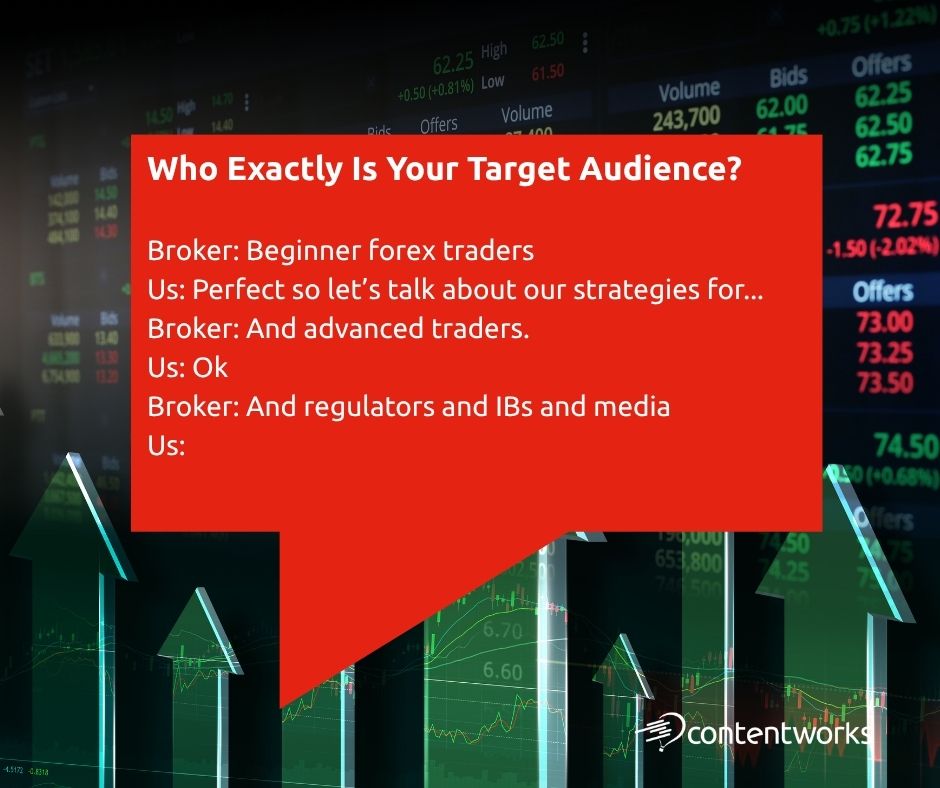
Describing the audience as “retail forex traders” is not sufficiently specific for a sophisticated marketing strategy. A broker could be targeting experienced active traders, newer retail investors, high-value clients, algorithmic traders, multi-asset traders or audiences in specific geographic markets. Each group has different motivations, levels of experience, information requirements and decision-making processes.
Learn how our forex marketing agency helps brokers acquire high-value traders
The regulatory environment also demonstrates why audience understanding matters. The FCA describes CFDs, including rolling spot forex, as high-risk products that are not suitable for all retail consumers and places specific requirements on firms regarding how these products are marketed and sold. That makes audience definition more than a creative marketing exercise. A broker needs to understand who its appropriate audience is, what that audience already knows, what information it requires before making a decision and what type of communication is likely to establish credibility. This will also impact the type of content we are able to create under each regulatory jurisdiction.
There is evidence that prospective clients encounter broker marketing across several digital channels. In the FCA’s 2024 Financial Lives research, 10% of UK adults said they had seen an online advertisement or promotional message for CFDs or spread betting during the previous 12 months. Search engines, Facebook and YouTube each accounted for 3% of adults reporting that they had seen a lot of such advertising, while Instagram accounted for 2%. The implication for brokers is not simply that they should advertise across all these platforms. Rather, the customer journey needs to be understood well enough to determine where awareness is created, when research happens and which channels are most likely to influence conversion for a particular audience.
What Are Your Customers Doing Before They Convert?
Understanding the target audience also requires understanding behaviours and funnels. A prospective trader may discover a broker through search, encounter its advertising on social media, consume educational content, compare reviews, investigate regulation, look at spreads and products, visit several competitor websites and only then decide whether to register.
For a more experienced trader, the journey may be shorter and centred on trading conditions, platform functionality, liquidity and execution. They will also want tailored insights and technical analysis on a daily basis. For a newer trader, education, risk information and platform usability may be much more important. For both groups, the reputation of a broker and its associated trust factors are paramount.
This is why a forex marketing strategy should be built around trader journeys rather than simply around channels. The objective is to understand what information a trader needs at each stage and then determine which content, media, PR and conversion mechanisms are appropriate. A broker that cannot describe this journey in reasonable detail is likely to be making assumptions about its audience rather than marketing to it.
What Are Your USPs? (And Don’t Say Lightning Fast Executions)
The second question that frequently exposes a strategic weakness is differentiation.
In our strategy calls, many brokers point to fast execution, competitive spreads, advanced trading platforms, multiple instruments and responsive customer support. These may all be important components of the proposition, but they are increasingly difficult to use as meaningful differentiation because competitors can make similar claims. They are also expected by most traders at this point.
A genuine USP might relate to a particular client segment, a specialist market, a distinctive product proposition, a technology capability, a differentiated educational offering, a specific geographic strength or a brand philosophy that is meaningfully different from competitors.
This matters because the market is already highly competitive. Finance Magnates reported that the five largest retail CFD companies by monthly trading volume collectively accounted for 38% of the market in Q4 2025, despite trading volumes more than tripling over that period. For a smaller or mid-sized broker, this reinforces the importance of positioning. Competing purely on generic claims is unlikely to create a strong reason for a prospective client to switch from an established brand.
Which Regions Do You Actually Want To Target?
In strategy calls, this part often looks like this:
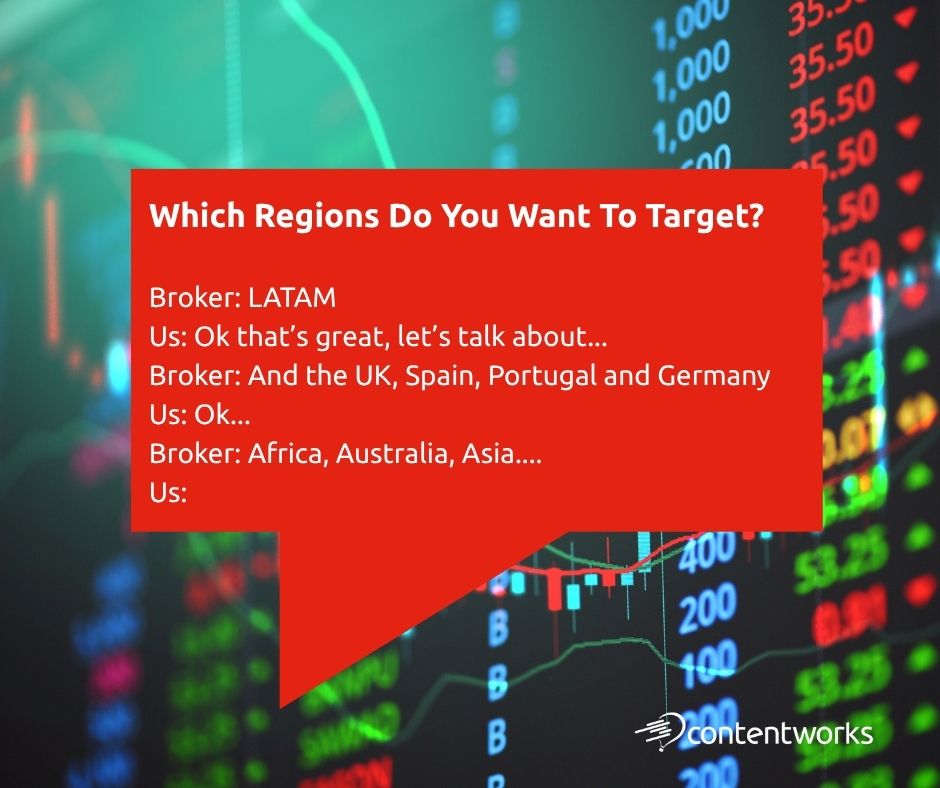
For international brokers, geographic strategy should be one of the first decisions made, rather than something determined retrospectively by where advertising happens to generate clicks. Recent data illustrates why. In February 2026, Europe accounted for 43% of global broker-directed online interest across the 120 countries tracked, compared with 23.5% for Asia-Pacific and 20.6% for North America.
Earlier data showed how quickly these proportions can change. In Q3 2025, Europe accounted for 37.7% of traffic to the websites of selected major CFD brokers, compared with 36.7% for APAC, 17% for North America, 3.6% for Latin America, 2.7% for MENA and 2.3% for Africa. The key strategic point is that “global” is not a geographic strategy.
A broker needs to determine which markets it wants to win and why. That decision then influences virtually every element of marketing, including language, content, SEO, paid media, PR, events, partnerships, support and social media.
It also affects localisation. Translating an English campaign into Spanish, Arabic or Portuguese does not automatically make it relevant to a local audience. Localisation requires consideration of terminology, cultural expectations, search behaviour, financial media, influencers, market sentiment and the way consumers evaluate financial brands. It also requires you to have localised support within your team.
The geographic strategy should therefore answer several questions:
- Which markets are priorities
- What commercial opportunity exists in each
- Which audience is being targeted
- What languages are required
- Which channels are relevant
- Which media outlets influence that audience
- How much PR and advertising budget should be allocated to each market
- How will I support these traders
- Do I need IBs in these regions
What Is Your Business Plan?
Another question brokers frequently struggle with is how marketing fits into the wider commercial strategy. In many instances we have found that the broker does not have a business plan for us to view.
Marketing objectives should not exist independently of business objectives. If the broker wants to increase funded accounts, enter a particular region, increase deposits, improve client quality or grow a specific product line, the marketing strategy needs to reflect those priorities. That means connecting commercial KPIs to marketing KPIs.
Example
If a broker’s business objective is to acquire beginner traders in Latin America, the marketing strategy needs to reflect the realities of that audience. Rather than focusing primarily on product-led acquisition messaging, the broker may need an educational marketing strategy designed to build awareness, trust and financial knowledge before asking a prospective client to register. This could mean Spanish and Portuguese educational content, beginner trading guides, webinars, explainer videos, localised SEO and educational campaigns across the channels used by prospective traders in priority LATAM markets.
The KPIs should then reflect the commercial journey. Marketing could track growth in organic traffic to educational content, engagement with beginner resources, registrations generated from educational campaigns, progression from registration to funded account and the acquisition cost of funded clients. Website traffic and content engagement remain useful, but they become much more meaningful when the broker can demonstrate that educational activity is moving prospective traders further through the acquisition funnel.
Without a business plan and a clear KPI framework, the broker may end up publishing hundreds of educational articles, running social campaigns and generating significant traffic without knowing whether those activities are contributing to the objective of acquiring and funding beginner traders in its target LATAM markets.
Are You Prepared To Put Your Executives Forward?
A further question that is often overlooked concerns transparency and leadership visibility.
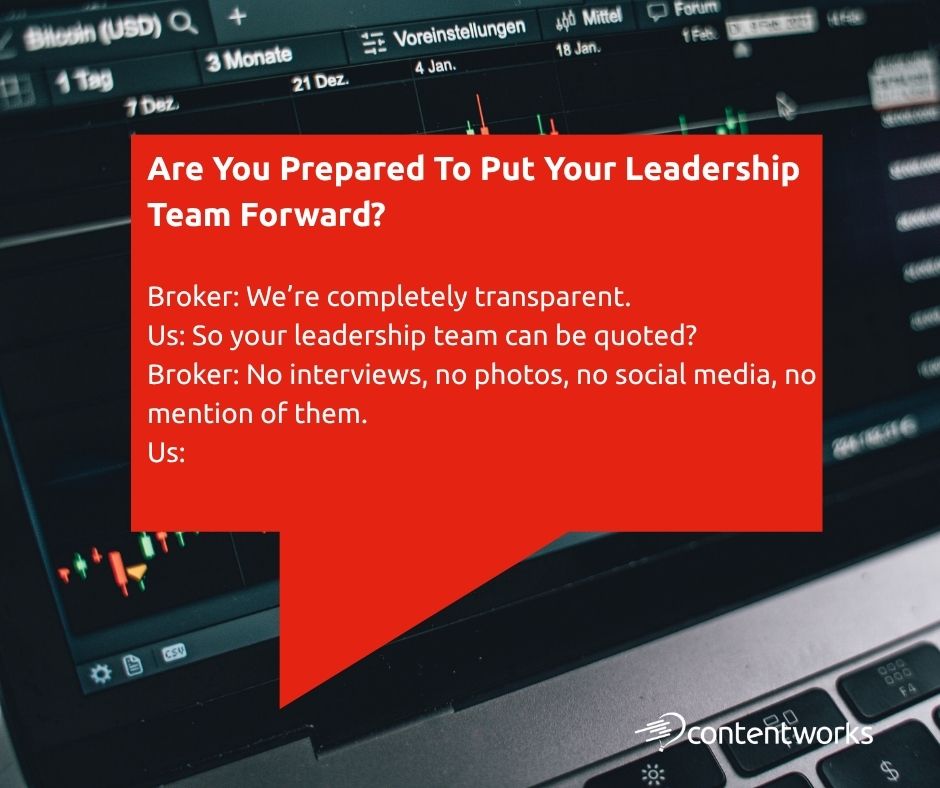
Is your broker prepared to put its founders, CEO or senior executives forward as public representatives of the business? This can have a significant impact on PR and thought leadership. A broker whose executives are willing to provide commentary, participate in interviews, speak at conferences, contribute opinion articles and discuss industry developments has considerably more opportunities to build authority than a company whose communications must always come from an anonymous corporate voice.
About EEAT
Brokers who are committed to sharing their insights, expertise and background are more likely to hit the EEAT sweet spot. EEAT is a quality framework used by Google to evaluate content.
- Experience which reflects first-hand or lived experience with a topic
- Expertise which shows demonstrated knowledge or skill
- Authoritativeness which is your knowledge and expertise as a reliable source
- Trustworthiness which relates to accuracy, transparency and integrity
Read about EEAT and why your leadership team needs it.
This does not mean every founder needs to become a social media personality. It means the business should decide whether senior leadership is willing to communicate openly and consistently about its expertise, positioning and perspective on the market.
The need for credible communication is particularly relevant in an industry where regulators continue to focus on the quality and appropriateness of financial promotions. The FCA’s ongoing work on CFD providers includes scrutiny of how brokers market and distribute these products and whether appropriate controls are in place. A transparent leadership strategy can therefore support both brand differentiation and credibility, provided communications are appropriately governed and compliant.
Book A Forex Marketing Strategy Call
If your team is finding it difficult to answer these questions, it may be time to revisit your marketing strategy. Speak to Contentworks Agency about your forex marketing strategy. We can help you to develop a market-led plan that brings together positioning, audience research, geographic targeting, localisation, content, PR, paid media and measurable business objectives. Book a Zoom call.