
Finance brands will always have something to say. Whether it’s a market update, sponsorship news or a product launch. The problem is not a lack of something to say but a lack of distinctive thinking. In our sector, everyone would like to be considered a financial thought leader, but they haven’t figured out what they want to be known for. Financial thought leadership should give people a reason to listen to your brand, trust its expertise and follow its people. Done well, it can strengthen reputation, support business development and help a financial institution stand out in a crowded market. It also gets you picked up by financial journalists for free. For banks, fintechs, investment firms and forex brokers, the opportunity is to turn real expertise into insights that customers and industry stakeholders cannot easily get elsewhere. Let’s look at how to do thought leadership for finance.
Why Thought Leadership For Finance Matters
Financial services is an expertise-driven industry. Customers are trusting institutions with their money, businesses are selecting partners to handle important operations, and investors are assessing organisations whose credibility can influence commercial decisions. Brand visibility matters, but visibility without substance has little value.
Thought leadership helps bridge that gap. It demonstrates how a financial brand understands its market, interprets change and responds to problems that matter to its audience.
The 2025 Edelman–LinkedIn B2B Thought Leadership Impact Report found that 95% of surveyed hidden buyers said strong thought leadership made them more receptive to sales and marketing outreach. These hidden buyers include influential stakeholders in areas such as finance, legal, procurement and operations who may not be the primary contact but can still affect a purchasing decision.
The same report found that 81% of decision-makers said high-quality thought leadership helped them understand previously unrecognised challenges or opportunities. That is a useful point to consider. Effective thought leadership does not simply persuade people that your business is credible, it helps them see a problem, or a possible solution, differently. With fintech selling payment infrastructure, that might mean explaining why a seemingly successful expansion strategy is creating hidden reconciliation costs. For a bank, it could mean examining the practical implications of changing customer expectations around digital identity. Forex brokers might challenge assumptions about trader acquisition and show why retention deserves more attention.
The point is to offer a perspective that helps the audience make better decisions, rather than simply reminding them that your brand exists.
Thought leadership can also support business development before a prospect ever speaks to sales. In complex financial markets, the person evaluating a solution may not be the only person influencing the final decision. A well-argued report, an insightful executive post or a useful industry analysis can give a brand credibility with stakeholders who would otherwise have little reason to engage.
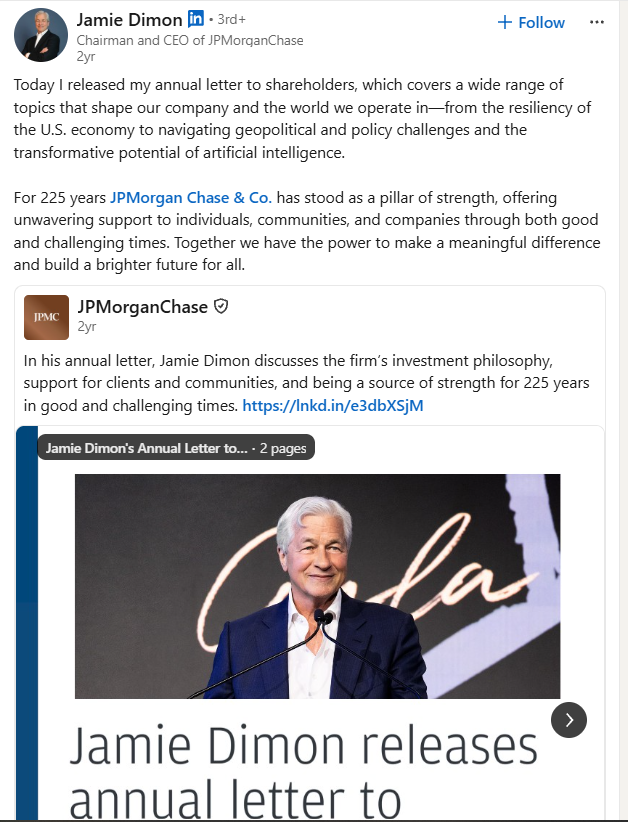
Jamie Dimon, JPMorganChase: executive perspective and a strong editorial point of view. His LinkedIn post above introducing the 2024 letter is a useful illustration of how an executive can frame a broad set of issues through their own leadership perspective.
Thought Leadership And EEAT
Thought leadership also has an important role to play in organic search visibility and the wider discovery of financial brands. Google’s E-E-A-T framework stands for Experience, Expertise, Authoritativeness and Trustworthiness. It is particularly relevant to content where inaccurate information could affect a person’s financial wellbeing. Google’s guidance explains why first-hand experience and appropriate expertise matter when assessing the quality of content.
EEAT is not a direct ranking score that a marketing team can optimise with a checklist. Nor does publishing a white paper automatically make a company authoritative. The principle is more fundamental: demonstrate why the people producing your content have the knowledge, experience and credibility to discuss the subject.
For financial brands, this means moving beyond anonymous articles and unsupported claims. Make sure to:
- Name the author
- Explain their relevant experience
- Link to original research and reputable sources
- Include meaningful commentary from subject-matter experts
- Keep regulatory and technical explanations accurate, current and appropriately reviewed.
As audiences use traditional search engines, AI-powered search experiences and professional networks to investigate financial topics, brands need useful information that can be understood, attributed and supported by evidence. Strong thought leadership can provide that foundation, although no content strategy can guarantee visibility in search or AI-generated answers.
Most importantly, EEAT should reflect genuine expertise rather than become another acronym to insert into a content brief. A brand earns authority by consistently contributing something worthwhile to the conversation.
How To Develop A Distinctive Point Of View
Financial brands often have more expertise than they realise. The challenge is extracting that knowledge from people who are busy running the business and turning it into content that audiences actually want to read.
A good starting point is to stop asking, “What should we post this week?” and start asking, “What insights do we have that will impact our audience?”
#1 Start With Customer And Industry Problems
Your editorial agenda should reflect the questions customers are asking, the decisions they are struggling with and the changes affecting their businesses. A bank might explore the realities of financing international expansion for SMEs. A payments provider could investigate why cross-border payment failures persist despite improvements in infrastructure. A forex broker might examine why traders abandon platforms or how changes in market volatility affect trading behaviour.
If you don’t have a Business Intelligence team, you can also speak to sales teams, relationship managers, analysts, compliance specialists and customer support. They hear the objections, misunderstandings and recurring frustrations that rarely make it into a conventional marketing brief.
#2 Build Proprietary Research Into Your Content Marketing Strategy
Research is one of the most effective ways to make thought leadership distinctive. It gives your organisation the opportunity to contribute original evidence rather than another interpretation of somebody else’s statistics.
You do not necessarily need a substantial research budget. Start by identifying data you already collect, then ask what it can reveal that might be useful to your clients or prospects.
- Banks: Investigate anonymised trends in SME borrowing, business cash flow, savings behaviour or demand for different financial products.
- Fintechs and payment providers: Explore payment friction, fraud patterns, transaction behaviour or the operational challenges of entering new markets.
- Forex brokers and trading platforms: Examine aggregated trading activity, instrument preferences, platform engagement, educational content consumption or differences in customer retention.
- Investment and wealth management firms: Research investor concerns, changing financial priorities, portfolio questions or attitudes towards emerging asset classes.
The important distinction is between publishing data and extracting insight from it. A chart showing a change in trading volume is useful, but an explanation of why that change matters to different types of market participants is much more valuable.
If you lack suitable internal data, commission a survey, interview customers or conduct structured research across a defined market. Publish the methodology, explain the limitations and avoid presenting a small or unrepresentative sample as an industry-wide finding.
Proprietary research also creates a valuable content asset. A single study can support a detailed report, a series of articles, executive commentary, media pitches, webinar discussions, conference presentations and social media content. If you’ve put a lot of effort into garnering the insights, maximise how you can repurpose that content (more on this further down).
#3 Give Your Experts A Platform
Your thought leaders can work with your marketing team to find the best outlet for their insights. They might be best suited to a regular spot at a niche publication that will be picked up by financial journalists. Alternatively they might be best placed on your blog or education channels, therefore allowing you to own the narrative and increase traffic.
Remember there are different formats to play with too. Podcasts, YouTube videos and Shorts or TikToks all provide great platforms for your financial thought leaders.
#4 Turn Industry Trends Into Content
Financial brands are well placed to comment on regulation, artificial intelligence, digital identity, payments infrastructure, cybersecurity, market volatility and changing customer expectations. But simply reporting that a development has occurred is not thought leadership. What adds the that element is interpretation, analysis, and essentially your own thoughts.
When a new regulation is announced, explain which business models may be affected, what operational changes organisations should consider and where uncertainty remains. When AI adoption accelerates, go beyond predicting transformation and examine the governance, data quality and accountability questions that financial institutions must resolve. The objective is is to help readers understand the forces shaping a decision, including what is not yet known.
#5 Make The Argument Recognisably Yours
A distinctive point of view does not require an unnecessarily provocative position, it requires unique perspectives backed up by research and experience. It should acknowledge legitimate counterarguments and explain where the thought leader’s experience supports that conclusion.
Over time, recurring themes create a recognisable editorial identity. Readers begin to associate your brand with areas of expertise, and your executives become known for contributing useful perspectives to those conversations.

Nik Storonsky shared reflections from a Bloomberg interview about the company’s IPO timing, international expansion, customer proposition and use of AI. Rather than simply announcing an interview, the post extracts the main strategic arguments and explains the thinking behind them.
How To Distribute Thought Leadership Effectively
Even excellent research has limited value if it remains buried in a website’s resource centre.
Start with a substantial original asset, such as a research report, expert analysis or executive viewpoint. Then adapt it for the channels your audience actually uses.
- Your website: Publish the full analysis, with a clear author biography, supporting evidence, references and related resources.
- LinkedIn: Share the argument, not just the link. Give the expert a personal voice and invite informed discussion.
- PR and media relations: Offer journalists original findings, credible spokespeople and commentary that adds something to a developing story.
- Events and webinars: Use research findings to frame discussions, brief panellists and give attendees something more valuable than a product presentation.
- Email marketing: Deliver concise insights to customers and prospects, with links to deeper analysis where relevant.
- Search and AI discovery: Structure content around genuine questions, clearly attribute expertise and make supporting evidence accessible.
- Video: YouTube Shorts and TikToks are great for breaking complex ideas and insights into easily digestible snippets. You can run a series or a regular 1 minute spot.
Distribution should not mean copying the same paragraph across six channels. Adapt the presentation while preserving the central argument.

JPMorganChase promoted research from its institute examining opportunities to improve business growth and access to capital for underserved businesses. This is a good illustration of a financial institution using research to contribute to a broader economic discussion, rather than focusing only on its own products.
It is also worth measuring more than impressions and likes. Track relevant referral traffic, branded search interest, media citations, report downloads, qualified enquiries, speaking invitations and engagement from target accounts. For longer sales cycles, ask prospects whether they encountered your research or followed an executive’s commentary before contacting you. No single metric proves that thought leadership generated a commercial outcome. A combination of audience quality, engagement, reputation signals and sales feedback gives a more useful picture.
What Finance Brands Should Avoid
Thought leadership can damage credibility when the content promises more than it delivers. Financial brands should be particularly careful about the following mistakes.
Manufacturing thought leaders
One of the issues we see time and time again is finance brands manufacturing their execs into thought leaders. A CEO is not necessarily a natural born thought leader, but your Sales Advisor might be. Manufacturing thought leaders can result in awkwardness if the person is faced with a live interview scenario and does not have any insights to share. Personality and charisma will also play a role in this.
Generic commentary
Rewriting a news announcement with phrases such as “the industry is evolving rapidly” adds little value. Explain what is changing, why it matters and what readers should do with that information.
Thinly disguised sales pitches
An article that spends most of its time promoting a platform or service is product marketing, not independent thought leadership. Commercial content has its place, but the purpose should be clear.
Unsupported claims and recycled statistics
Cite original sources, check dates and explain the methodology behind your own research. Don’t fall into the trap of turning correlation into causation or imply that a small sample represents an entire market.
Executive ghostwriting without executive insight
Supporting your executive team to shape their opinion is sensible, making one up for them is not. Interviews and collaborative drafting should reflect the person’s genuine experience and perspective.
Overconfident financial predictions
Markets are uncertain so commentary should explain assumptions, scenarios and risks rather than present speculation as fact. Trading-related content must also comply with applicable financial promotion rules and local regulations.
Publishing for the sake of frequency
A weekly thought leadership post is not automatically better than a genuinely useful monthly contribution. Consistency matters, but only if the quality remains high.
Ignoring compliance and governance
Research, customer data, forward-looking statements and market commentary may all require specialist review. Establish an approval process that protects accuracy without stripping every piece of content of its substance.
Make Your Expertise Count
Financial thought leadership is not about producing more content. It is about making your organisation’s expertise visible, useful and distinctive. The strongest programmes combine proprietary research, expert commentary, industry analysis and executive perspectives around the issues that matter to customers and stakeholders. They build on what the organisation genuinely knows, challenge assumptions where the evidence supports it and explain complex subjects without oversimplifying them.

Chris Beauchamp is a useful example of a named market specialist whose expertise is central to the brand’s public-facing analysis. IG shared a LinkedIn post about his City AM Awards 2026 Analyst of the Year nomination, highlighting the importance of helping investors cut through market noise.
For financial brands investing in finance content marketing, this is an opportunity to move beyond competing for attention and start earning it.
Want to turn your financial expertise into content that builds authority and supports business growth? Contentworks helps financial services brands develop research-led content strategies, executive thought leadership, industry commentary and original research that give audiences a reason to pay attention.
Speak to us about financial thought leadership and find out how we can help your brand contribute something meaningful to the conversation.