
At Contentworks Agency, we are often asked the same question by finance brands investing in SEO and content marketing. How do we get our traders and investors to trust us? Of course, complying with regulations and behaving fairly is core. But when it comes to marketing, the answer is EEAT which stands for Experience, Expertise, Authoritativeness and Trustworthiness. EEAT is a quality framework used by Google to evaluate content and in this guide, we explain what E-E-A-T is, how Google evaluates it, plus how to write content that supports E-E-A-T.
What Does E-E-A-T Stand For?
- Experience which reflects first-hand or lived experience with a topic
- Expertise which shows demonstrated knowledge or skill
- Authoritativeness which is your knowledge and expertise as a reliable source
- Trustworthiness which relates to accuracy, transparency and integrity
Originally introduced as E-A-T, Google added the extra “E” for Experience in 2022 to reflect the growing importance of real-world insight rather than purely theoretical knowledge.
E-E-A-T is especially important for YMYL, or Your Money or Your Life, topics like finance, health, legal and safety content. However, it also applies to any content that aims to rank, influence or inform.
Is E-E-A-T a Ranking Factor?
E-E-A-T is not a single ranking signal. Instead, Google uses it as a quality assessment framework that influences how algorithms interpret content value. In practice, you do not optimise directly for E-E-A-T. You optimise your content, authorship, site structure and brand presence so Google can recognise experience, expertise, authority and trust.
Read about SEO, GEO and how to optimise for AI

How Google Scores E-E-A-T
Google evaluates E-E-A-T holistically rather than through one measurable score. Its systems look at multiple layers of signals to determine how trustworthy and authoritative a page or brand appears.
#1 Content Signals
At the content level, Google assesses whether the information itself demonstrates value, accuracy and usefulness for the reader.
- Depth, accuracy and originality
- First-hand experience and real examples
- Clear sourcing and citations
- Absence of misleading or exaggerated claims
High-quality content goes beyond surface explanations and avoids vague or generic statements.
#2 Author Signals
Google also evaluates who is responsible for the content and whether that person or organisation is qualified to speak on the topic.
- Named authors with detailed bios
- Demonstrable credentials or professional experience
- Consistency of expertise across subject areas
- Presence across the web, including LinkedIn profiles, publications or speaking engagements
Clear authorship helps Google connect expertise to real people rather than anonymous content.
#3 Website Signals
Beyond individual pages, Google looks at the overall quality and transparency of the website publishing the content.
- Clear ownership and contact information
- About, editorial and policy pages
- Secure browsing using HTTPS
- Consistent publishing and regular content updates
These signals help establish whether the site operates as a legitimate and trustworthy publisher or business.
#4 Off-Site Signals
Google also considers how the wider web perceives your brand, content and expertise.
- Brand mentions across reputable websites
- Backlinks from relevant and authoritative sources
- Reviews, citations and PR coverage
External validation reinforces authoritativeness and trustworthiness over time.
Writing Content for E-E-A-T
At Contentworks Agency, we build E-E-A-T into content strategy from the outset. Below are some of the steps we take to strengthen E-E-A-T across client content.
#1 Demonstrate Real Experience
Experience is the newest and most misunderstood element of E-E-A-T. Google increasingly favours content that demonstrates first-hand use, direct involvement or lived professional insight. To demonstrate experience:
- Use real examples, campaigns or case studies as we have included on our portfolio
- Share lessons learned, challenges and outcomes by the company or key team members
- Avoid generic summaries that could apply to any brand (this is especially prevalent in the AI age!)
Experience differentiates your content from mass-produced or purely AI-generated articles and this matters when a trader or investor is evaluating you.
#2 Prove Expertise Clearly
Expertise is not about sounding academic. It is about showing a deep and practical understanding of a subject. Effective ways to demonstrate expertise include:
- Explaining complex ideas clearly and accurately in a whitepaper or longform article
- Going beyond surface-level definitions – something that is key in the finance space
- Anticipating reader questions and objections and incorporating them into your content
- Referencing recognised frameworks, standards or data. At Contentworks we closely follow key financial regulations and produce roundups each month.
#3 Strengthen Authority
Authoritativeness reflects whether others recognise you as a credible source. To build authority through content:
- Publish under real authors with consistent bylines. This needs to be a regular activity to build recognition, you can see a great example from Gerald at FX News Group below.
- Include author bios that explain experience and credentials, keep them updated across all platforms
- Create topic clusters instead of isolated blog posts. This works especially well in financial education centres
- Earn backlinks through PR, partnerships and guest content
Authoritativeness builds over time, and consistency is more important than volume.

#4 Build Trust at Every Level
Trustworthiness is the foundation of E-E-A-T. Without the trust element; experience and expertise lose their impact. In the financial services space trust is paramount. Whether you have a bank, fintech, forex broker, payments company or prop trading brand, clients want to know that their funds are safe.
Learn how Contentworks helps finance brands earn and keep it
Key trust-building practices include:
- Ensuring factual accuracy and regular updates, we recommend clients update core landing pages and blogs on a yearly basis
- Being transparent about authorship and ownership, never copy work from others or plagiarise ideas without citing sources
- Avoiding exaggerated or misleading claims especially when discussing financial services products
- Using clear, honest calls to action and ensure content is compliance checked
From a technical SEO perspective, trust also includes secure browsing, clean site design and the absence of intrusive or deceptive user experiences.
Are E-E-A-T, SEO and GEO Connected?
As AI Overviews, generative search and answer engines become more prominent, E-E-A-T plays an increasing role in which brands are cited, summarised or recommended. Generative Engine Optimisation relies heavily on authoritative sources, expert-led content, recognisable brands and strong trust signals.
Strong E-E-A-T increases your chances of:
- Being cited in AI-generated answers
- Appearing in featured snippets
- Ranking for competitive keywords
- Building long-term organic visibility
Benefits of E-E-A-T for Content Marketers
Investing in E-E-A-T delivers benefits beyond search rankings.
- Higher Content Credibility. Audiences are more likely to trust content written by experienced and knowledgeable sources.
- Improved Conversion Rates. Trust reduces friction and leads to higher-quality leads and enquiries.
- Greater SEO Stability. E-E-A-T content is more resilient to algorithm updates.
- Stronger Brand Equity. Your brand becomes associated with authority and reliability rather than just keywords.
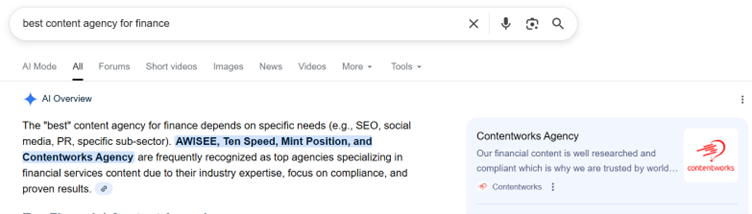
- Increased AI Search Visibility. Authoritative content is more likely to be surfaced and referenced by generative search engines as you can see in the screenshot below.
E-E-A-T is a long-term content and brand strategy. The brands succeeding in SEO, GEO and AI-driven search are not publishing more content. They are publishing better, more credible and more human content.
At Contentworks Agency, we integrate E-E-A-T into our content strategies, SEO and GEO architecture, author positioning and brand messaging. Book a free Zoom with our team to start improving your EEAT.