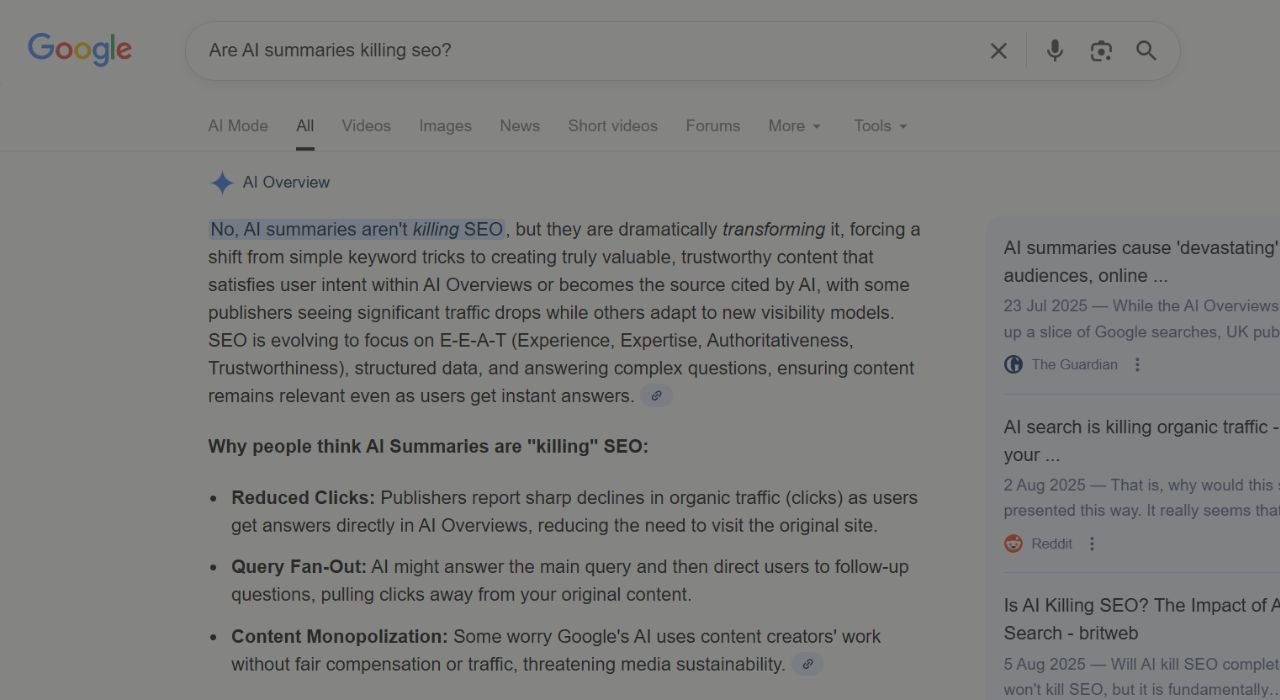
The introduction of Google AI Overviews, Bing Copilot, and generative answers across search and chat interfaces has really shaken up the search game. And it has got marketers worried. That’s because instead of guiding users to websites, search engines are increasingly designed to resolve queries directly. Are AI summaries killing your SEO? At Contentworks Agency, we certainly see that traditional SEO is being redefined. Let’s share some insights.
Learn How to Optimise Content for GEO Or AI-Generated Search
What Is An AI summary?
AI summaries, also known as AI Overviews or generative search answers, are responses created by large language models integrated into search engines. These systems analyse vast quantities of web content, identify patterns, and synthesise information into a single response designed to satisfy user intent instantly.
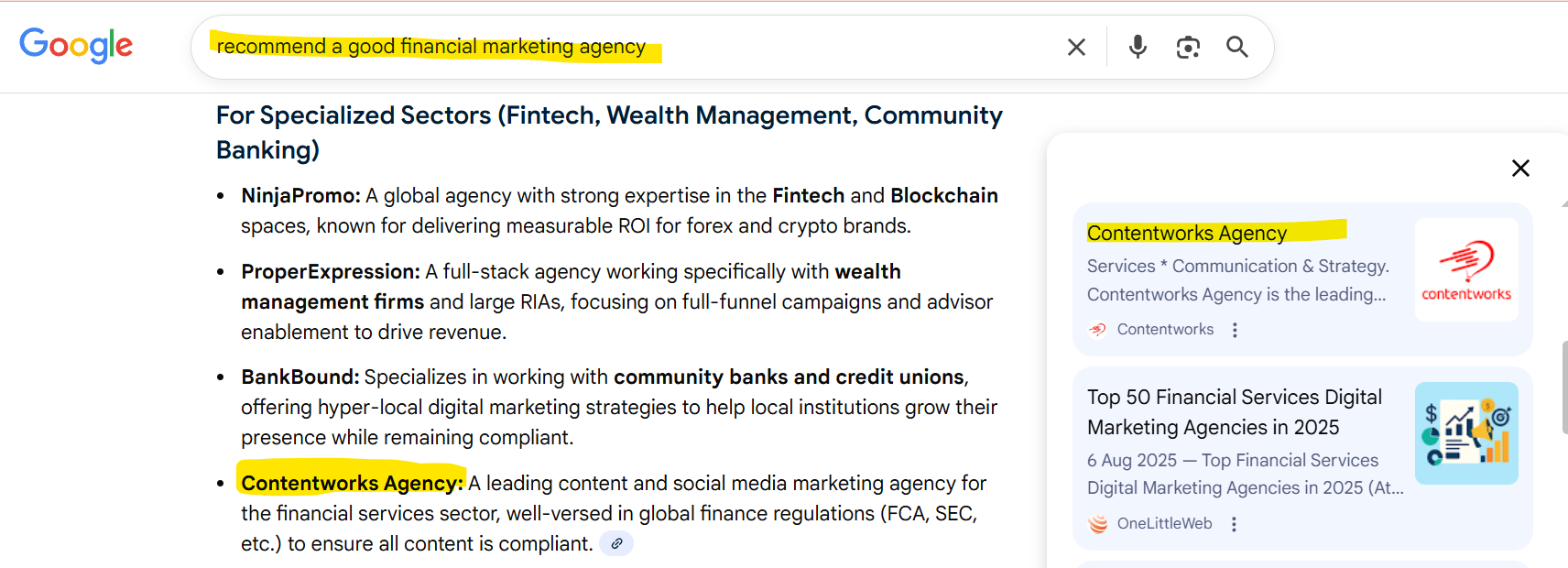
An AI summary looks like this. The main summary appears at the top of your feed, overshadowing any organic or paid links. On the right are the links related to the AI summary. You can see we highlighted how Contentworks Agency appears in the AI summary and the right column links.
Rather than ranking pages purely by links and keywords, AI systems prioritise:
- Semantic understanding of topics
- Authority and trust of sources
- Consistency of information across the web
- Clear, structured explanations
Google has publicly stated that AI Overviews are powered by its most advanced language models and rely heavily on high-quality, authoritative content. Pages that lack depth, originality, or credibility are far less likely to be referenced or cited.
This means AI summaries do not replace SEO signals. They amplify them. Content quality, expertise, and clarity now directly influence whether a brand appears in generative answers. Around 58% of all search queries now result in “zero-click” outcomes. This is where users get answers directly from AI summaries without clicking through to websites. AI summaries accelerate this trend by answering more complex, multi-layered questions that previously required several page visits. For brands, publishers, and marketers, the result is a loss of visibility, influence, and control at the very top of the funnel. This has led many to ask whether SEO still works at all.
Zero-click search explained in depth
A zero-click search occurs when a user completes their task on the search results page without clicking through to another website. This can happen through featured snippets, knowledge panels, local packs, and now AI summaries. Informational queries such as definitions, comparisons, and “how does X work” searches are the most affected. AI summaries often answer these queries fully, removing the need for a follow-up visit.
But zero-click does not mean zero value because AI answers still shape:
- Brand recognition
- Perceived authority
- Trust at early decision stages
In practice, SEO has shifted from being a traffic-only discipline to a visibility and influence channel. Brands that appear repeatedly in AI-generated answers gain mindshare even if immediate clicks decline.
The Impact Of AI Summaries On SEO Performance
AI summaries are rapidly changing how search performance should be evaluated and rankings alone no longer tell the full story. As generative answers dominate the top of the search results, SEO success is increasingly defined by visibility, authority, and inclusion within AI-driven responses rather than traditional traffic metrics alone.
Declining click-through rates at the top of the funnel
SEO platforms have reported noticeable drops in click-through rates for queries that trigger AI Overviews. Even pages ranking first organically can experience reduced engagement when an AI summary dominates the viewport.
Increased competition for fewer organic links
AI summaries reduce the number of visible organic listings above the fold. This concentrates competition and increases the value of being one of the sources referenced by AI.
Greater emphasis on authority and brand signals
Generative systems prefer well-known, trusted entities. This aligns closely with Google’s E-E-A-T (Experience, Expertise, Authoritativeness, and Trustworthiness) framework. Brands with weak identity signals struggle to surface, regardless of keyword optimisation.
Higher quality, lower volume traffic
While total organic sessions may decline, conversion data often improves. Users who click through after reading an AI summary tend to have clearer intent and higher readiness to engage, making them more valuable from a commercial perspective.
The Challenges Marketers Face
The fundamental challenge organisations face is not the emergence of AI-driven search. Instead it is the persistence of outdated SEO mindsets. Many businesses continue to apply optimisation models that were designed for a pre-generative search environment, where rankings and keyword frequency were the primary indicators of success. As a result, SEO efforts are often fragmented and misaligned with how modern search engines and language models interpret content. Pages are still optimised in isolation, rather than being developed as part of a cohesive topic ecosystem that demonstrates depth, relevance, and authority.
Success is also frequently measured through narrow metrics such as rankings and session volume alone, without accounting for visibility within AI-generated answers, brand influence, or the quality of engagement further down the funnel. In an AI-driven search landscape, these approaches may limit performance and prevent brands from achieving the authority signals that modern search systems increasingly reward.
How Contentworks Agency Approaches SEO and GEO
Just to reiterate, traditional SEO is not dead, and AI summaries did not kill your SEO. That said, we are now combining SEO and GEO (Generative Engine Optimisation), to ensure our clients remain visible both in classic organic results and in AI-generated answers.
We structure content around recognised entities, concepts, and relationships. This helps search engines and language models understand not just what a page says, but what it means within a broader context.
Creating content AI systems can summarise accurately
We write content specifically for interpretability. This includes:
- Clear definitions early in the content
- Logical heading hierarchies
- Concise explanatory sections
- Supporting evidence and examples
AI systems favour content that can be reliably summarised without distortion.
Building content that AI wants to reference
Generative answers rely heavily on authoritative explanations. Thin content rarely qualifies. Our content strategies focus on:
- Long-form guides that fully cover a topic
- Original insights based on real-world experience
- Expert commentary and opinion
- Data-supported claims
- High quality backlinks and citations
This depth increases the likelihood of being referenced in AI summaries and cited as a source.
Intent-led topic clustering and content ecosystems
Rather than targeting individual keywords, we build topic clusters that address an entire search journey. This includes:
- Informational content for early awareness
- Comparative content for consideration
- Conversion-focused pages for decision stages
This interconnected structure reinforces topical authority and improves both traditional rankings and generative visibility.
Optimising for citations, not just clicks
Being cited in an AI summary delivers brand exposure even when users do not click. Over time, this builds familiarity and trust. We optimise for citation by:
- Writing quotable definitions and only sourcing from high quality sites
- Using neutral, factual language as opposed to fluff
- Reinforcing consistent brand expertise across content
- Creating unique whitepapers, eBooks and research papers
This positions our clients as dependable reference points for AI systems.
Strengthening E-E-A-T and brand trust signals
In theory AI systems are risk-averse by design (or they intend to be!). They aim to prioritise sources that demonstrate credibility and consistency. Our approach strengthens E-E-A-T through:
- Visible expert authorship and thought leadership
- Robust about and author pages for our clients
- Alignment between on-site content, social media, PR, and off-site mentions
- Consistent brand messaging across platforms
This makes brands recognisable entities rather than anonymous publishers.
Our advanced SEO and GEO techniques include:
- Entity-based optimisation aligned with knowledge graphs
- Answer-first content formatting
- Conversational, natural-language writing
- Long-tail, high-complexity query targeting
- Continuous content refresh and optimisation cycles
- Brand-led SEO strategies that prioritise authority over volume
These techniques are designed to future-proof visibility as search continues to evolve.
So, Is SEO Dead?
SEO is not dead or dying. It is just shedding outdated practices and aligning with the way people are searching for information in 2026 and beyond. Brands that succeed in the AI search era will:
- Understand how generative systems evaluate content
- Measure success beyond clicks and sessions
- Invest in high-quality, expert-led content
- Continue to care about good SEO practices
And some great news for the financial services space. GEO is still relatively new, so now is a great opportunity to get your forex broker, bank, fintech or payments provider noticed. Ready to start publishing SEO/GEO savvy content? Book a free Zoom call with our team.