If your rankings or organic traffic have dropped in 2026, you’re not alone. Google’s latest core updates represent a fundamental shift in how content is evaluated and ranked and it hasn’t been good news for many. Google explains that its systems aim to prioritise those that seem most helpful using a mix of signals tied to quality and usefulness. What does that even mean? Sit down with our team as we explain why your traffic and rankings dropped and how to fix it.
Detailed Breakdown of Google Core Updates in 2026
Contentworks Agency Director Charlotte says:
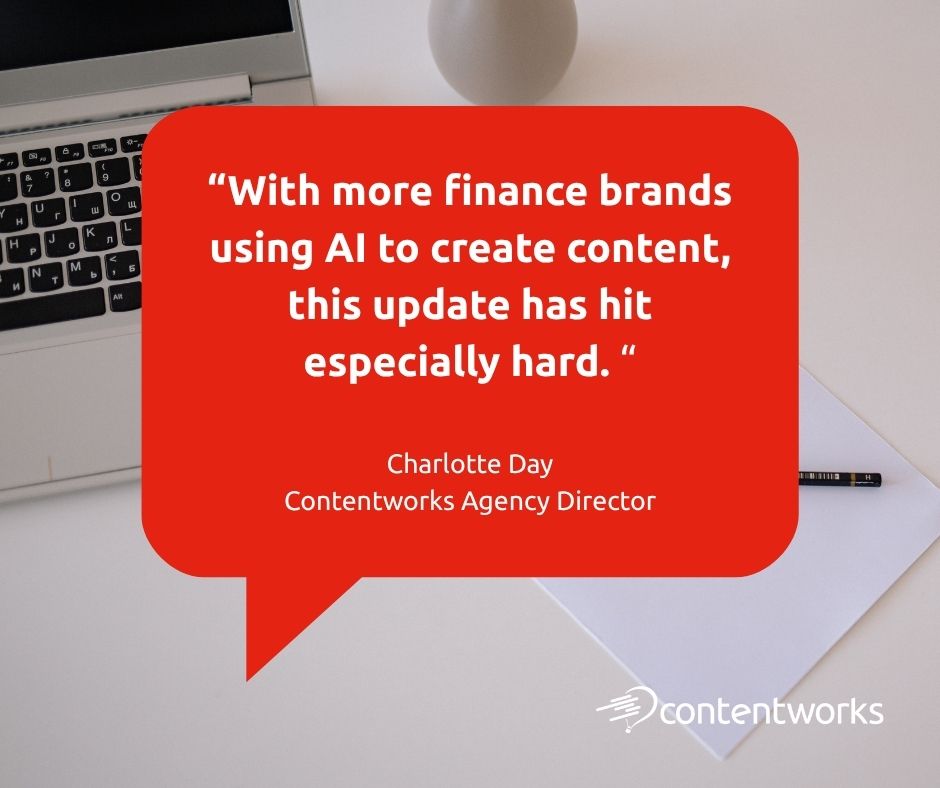
If you haven’t been paying close attention to Google’s updates this might all seem like a lot. At Contentworks Agency we closely follow core updates and how they impact our clients, media outlets and of course ourselves. With more finance brands using AI to create content, this update has hit especially hard. Let’s break it all down.
#1 December 2025 Update: The Foundation
Before looking at 2026, it is important to understand the December 2025 Core Update because it set the baseline for everything that followed.
Key statistics:
- 40% to 60% of websites were negatively impacted globally
- 71% of affiliate sites saw negative impact
- 67% of YMYL sites such as finance and health were affected
This update was a system-wide recalibration of quality thresholds rather than a targeted penalty.
Key changes
Experience became a ranking differentiator
Google began prioritising content that demonstrates first-hand experience rather than rewritten knowledge. Google evaluates whether content shows actual experience with the subject matter. This is why generic “10 tips” articles without real expertise are declining in visibility.
Content necessity became a factor
Generic beginner guides lost visibility while original research and expert insights gained rankings. Google is filtering out content that exists only because SEO demanded it. Forex brokers need to sit up and pay attention to this one.
Quality threshold increased
Google raised the minimum quality threshold to compete. Many ranking drops are not penalties. They are relative losses against better content.
#2 March 2026 Core Update: E-E-A-T as a Ranking Lens
The March 2026 update doubled down on the changes from December 2025. Google now evaluates content using the signals of Experience, Expertise, Authoritativeness, and Trustworthiness . Google states that it gives even more weight to content for topics that could impact financial stability or safety.
Key changes
Real expertise over surface-level content
Content written by experts now outperforms generalist content. Google rewards pages with first-hand insights, case studies, and real data. For finance brands this could be analyst insights, employee interviews, insights from your marketers or IB authored content.
AI content filtering improved
We’ve talked about this before but here we see again that low-quality AI content is de-ranked by Google. Human written, expert material outperforms generic AI output every single time. In terms of content marketing, you can use AI for research (although do double check sources and compliance), but don’t rely on it to author your content if you want to rank.
Intent matching became more advanced
Google is better at interpreting why someone searches. Informational content must educate. Transactional content must convert. Comparison content must guide decisions.
#3 Helpful Content Systems and People-First Focus
Google guidance stresses prioritising content that genuinely helps users. In 2026, helpful content is not just about explaining a product or feature. Instead, it solves the user’s problem completely, demonstrates real expertise, and guides them through next steps clearly. From our experience, fintech clients with content that combines expert insight, clear visual explanations, and actionable guidance outperform competitors in both rankings and engagement. Google is acting more like an editor than a search engine, rewarding content that is structured, easy to navigate, and genuinely useful, rather than content created purely for SEO.
Example: Rewriting tutorials to include step-by-step visuals, regulatory clarity, and practical tips resulted in a 35% increase in session duration and faster ranking recovery post-update for our digital banking client.
#4 UX and Experience Signals
User experience now directly influences rankings. Google considers page speed, mobile usability, navigation clarity, and engagement signals like time on page, scroll depth, and form completions. Even top-quality content underperforms if the experience is poor.
From our work with finance clients, we have seen pages with expert content drop 25% in rankings due to slow mobile load times and confusing navigation. After redesigning for faster load speeds and simpler navigation, rankings recovered and engagement metrics, including session duration and form completions, increased by 30%.
Forex sites often suffer from friction in accessing key information. When we restructure content hubs with clear steps, charts, and immediate access to insights, clients consistently see ranking improvements and higher engagement.
Our agency insight here is that SEO and UX are inseparable. A seamless experience not only improves user satisfaction but also signals trust and authority to Google, particularly for YMYL sites. Practical steps we implement include:
- Reducing page load times below 2.5 seconds
- Ensuring critical content is reachable within three clicks
- Enhancing mobile-first navigation
- Using scroll depth and time on page to track engagement
- Adding visual tools like charts and calculators to simplify complex information
In short, superior UX amplifies the impact of high-quality content, driving rankings, engagement, and trust.
#5 Brand Authority and Entity Signals
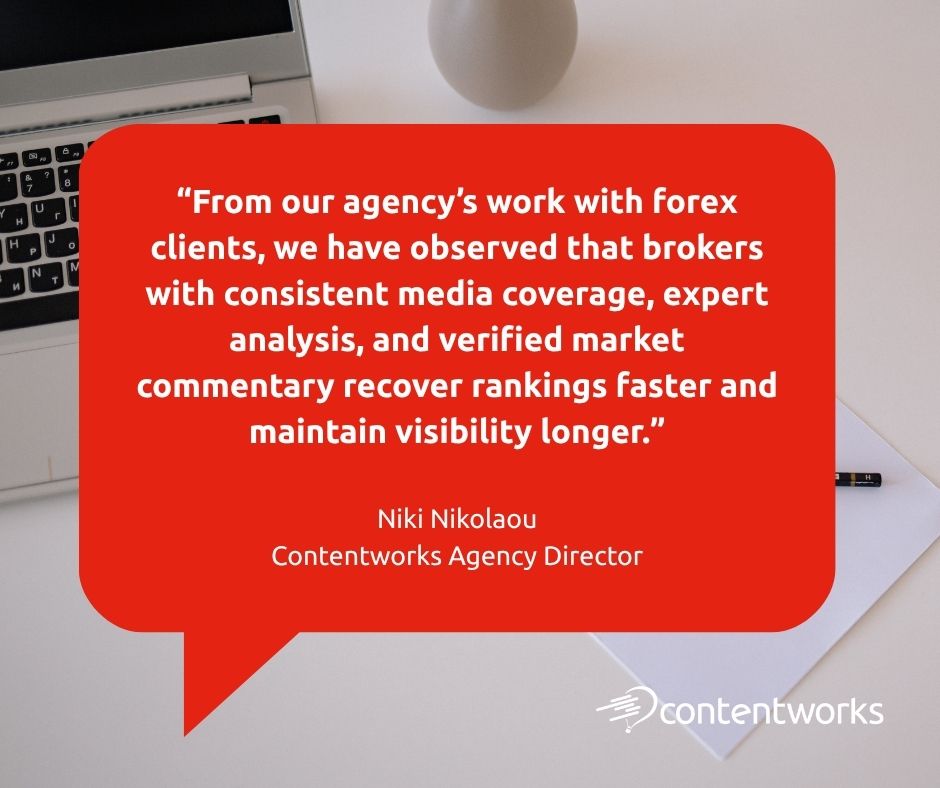
The 2026 updates reveal a clear shift toward evaluating brand authority. Google now considers brand mentions, reputation, reviews, and authority signals across the web. Contentworks Agency Director Niki says:
For example, one of our forex clients providing multi-region trading services saw a 35% increase in high-value keyword rankings after we implemented a coordinated strategy combining analyst-authored market reports, trader testimonials, and strategic PR placements on financial news sites.
Our team has consistently seen that in forex, SEO is no longer just about optimising individual pages. Google increasingly evaluates entity-level credibility, meaning that establishing the broker or platform as a trustworthy and authoritative brand is essential. Rankings now favour forex brands that demonstrate expertise, reliability, and a strong reputation across multiple channels rather than relying on isolated content pieces.
How Brands Have Been Impacted
From an agency perspective, the 2026 core updates exposed structural weaknesses in content strategies that were previously masked by scale and keyword targeting. Across client portfolios, several patterns have emerged.
#1 Traffic Volatility Has Shifted from Page-Level to Site-Level
Historically, updates impacted individual pages or keyword clusters. In 2026, the recalibration is site-wide. Entire blog sections have lost visibility while commercial pages remained stable.
Weak content in one area can now drag down performance across the entire domain. We need to get back to basics and do a complete site audit.
#2 Content Volume Strategies Are Breaking Down
Many clients came into 2026 with high-volume content strategies, but the problem is, these were not human written with original insights. Mass publishing AI produced content has taken its toll on these brands as follows:
- Sites publishing 50+ articles per month lost up to 60% percent of organic traffic
- High-volume blogs underperformed compared to curated content hubs
- Large portions of content no longer ranked, creating index bloat
More content no longer equals more traffic because AI overproduction can dilute authority and harm rankings.
#3 Authority Consolidation Is Accelerating
From our agency experience, we observed this trend first-hand. For example, a global digital payments provider that consistently publishes thought leadership articles, showcases partnerships with major banks, and features customer success stories saw its visibility in competitive SERPs increase by 30% after the March 2026 core update. Meanwhile, smaller regional payment platforms targeting the same keywords lost rankings despite having well-optimised content because they lacked the brand authority and external endorsements that Google now favours.
Our team has found that in payments and fintech, rankings are increasingly tied to entity-level authority. Brands that combine high-quality content with visible reputation signals, partnerships, and media coverage consistently outperform smaller competitors, even when content quality is similar.
#4 Informational Content Is Under Pressure
Top-of-funnel content such as “what is…” articles and beginner guides lost rankings. Pages must now add new value, demonstrate real experience, and fully satisfy user intent to remain visible. So instead of “10 tips for Traders” an article might be more focused such as “How USD/EUR Trader John Traded the NFP”. At Contentworks Agency we research keywords for SEO/GEO, analyse the financial markets and then map out your perfect content pillars and clusters. Book a free call with our team.
#5 Discover Visibility Drives Disparity
Clients with strong Discover presence have experienced high volatility in traffic following the 2026 core updates. In practice, this means that finance brands whose content frequently appears in Google Discover can see sudden spikes or drops depending on the perceived quality, authoritativeness, and timeliness of their content.
Our agency insight is that in the finance sector, appearing in Discover now requires consistently high-quality, timely, and authoritative content. Brands that maintain expert authorship, provide unique insights, and refresh content frequently are more likely to benefit, while those relying on volume or generic updates risk seeing traffic swings.
Client-Level Observations In Forex and Fintech
Forex Sites: Authority and Trust Are Table Stakes
Generic forex keywords lost ranking as did AI-generated trading guides which were largely de-ranked. Region-specific pages targeting countries like Cyprus or Singapore outperformed generic global pages.
Agency insight: Forex clients need expert-driven content, localisation, and explicit trust signals such as licensing and regulatory disclosures.
Fintech Clients: UX and Experience Signals Drive Rankings
Authority consolidation favoured fintech platforms with regular PR coverage or media mentions. Small startups without external authority lost rank due to inconsistent output.
Agency insight: Fintechs, especially startups often publish bulk content when they launch, then fail to keep updating. Regular blog content and social media posts are key.
Topical Authority and E-E-A-T Are Critical For All Finance Brands
Thin blogs and FAQ pages dropped in visibility, while long-form content demonstrating expertise and structured guidance rose in rankings. Author credibility is essential. Content clusters outperform isolated posts. Localised financial guidance now outperforms national-level advice.
Agency insight: Authoritativeness, topical depth, and localised expertise are non-negotiable. Check out the regional eBooks we produced for PayRetailers.
Action Plan for Impacted Brands
If your finance brand has been impacted by Google’s latest round of updates, it could be time to go back to basics. Let’s run through a final checklist of what you should do and not do to recover.
- Stop creating mass produced AI content. Take a pause and speak to us about strategic content that will actually achieve the outcomes you want.
- Expertise is mandatory, utilise internal talents, partners, IBs and affiliates. Inject expertise into key pages.
- Shift from content production to content investment. Content needs strategy and planning to have an impact in 2026.
- Build content around topic clusters keeping in mind SEO, GEO and real human intention.
- Redesign your funnels, education pages and asset information to be fewer clicks, less time and easier to navigate.
- Review your online reputation including negative reviews, articles and press releases.
Brands that start prioritising high quality content will recover lost traffic and outperform competitors. Book a free Zoom call with our team to get started.