
Every April, Financial Literacy Month highlights a growing global issue; only around 33% of adults globally are financially literate. That’s a shocking stat. While access to financial services has expanded rapidly, understanding has not kept pace. Digital banking, forex trading platforms, and fintech apps have lowered barriers to entry. Consumers can now invest, trade, borrow, and save with just a few taps but ease of access does not equal informed decision-making.
People are participating in financial systems without fully understanding how they work. This creates risk not only for individuals, but also for the financial brands serving them. Financial Literacy Month is not just a campaign. It’s a strategic moment to address a fundamental gap that impacts acquisition, retention, and trust. Let’s look at Financial Literacy Month and why education matters now more than ever.

Image from the Council For Economic Education
The Financial Literacy Gap in 2025: Key Stats
- Financial literacy levels remain stagnant, with adults scoring only about 49% on financial knowledge assessments.
- 74% of adults say they would have made better financial decisions if they had received financial education earlier.
- Around 75% of people report they were never taught personal finance at school.
- Lack of financial knowledge cost individuals an average of $948 in 2025 alone, highlighting real financial consequences.
- Only 40% of adults in developing economies save in a financial account, showing a gap between access and understanding.
- Nearly 700 million women worldwide remain underserved by the financial system, particularly in developing economies.
- Women are expected to control over 40% of global wealth by 2030, yet financial knowledge gaps persist.
The State of Financial Education Today
Financial literacy is no longer just about understanding budgeting or saving. It now includes navigating digital assets, evaluating investment risk, understanding inflation, and making long-term financial decisions in a volatile global economy. Yet despite this growing complexity, education has not scaled at the same pace.
- Younger audiences are entering financial markets earlier, often through mobile-first platforms. At the same time, many lack foundational knowledge. This creates a disconnect between behaviour and understanding.
- Around 60% of Gen Z invest before the age of 25, significantly earlier than previous generations.
- Nearly 70% of Gen Z and millennials use mobile apps as their primary way to manage finances and investments.
- Over 40% of young investors say they learned about investing from social media, rather than formal education or financial advisors.
- Only 24% of millennials demonstrate basic financial literacy, despite high participation in financial products.
- Most Gen Z report low confidence in understanding investing concepts such as risk, diversification, and inflation.
- More than one in three young investors admit to making financial decisions they did not fully understand.
- Short-form content platforms are a key source of information, with over 50% of Gen Z relying on platforms like TikTok or YouTube for financial advice
- Nearly two in five young adults (18–34) report struggling to repay debt, compared with lower rates in older age groups, highlighting ongoing financial pressure among younger borrowers.
For financial brands, this creates a powerful opportunity to lead through education. Check out the financial education we have delivered for our clients.

The Rise of Buy Now, Pay Later and Its Implications
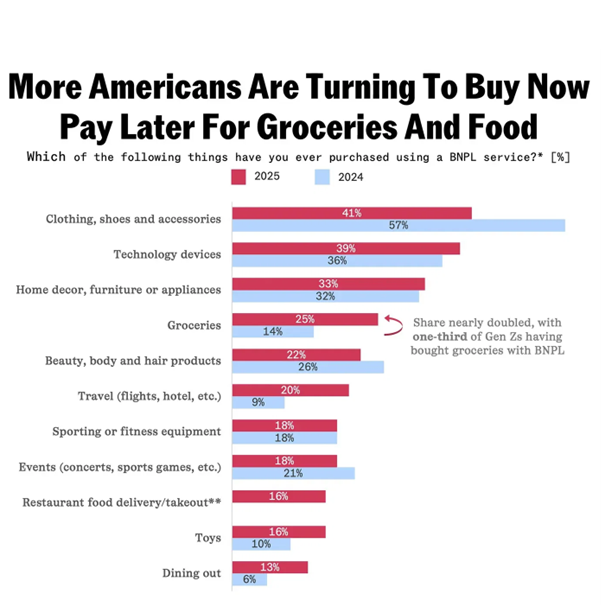
One of the fastest-growing trends in consumer finance is Buy Now, Pay Later (BNPL). Originally popularised by fintechs like Klarna and Afterpay, BNPL allows consumers to split purchases into interest-free instalments, often with minimal credit checks. Adoption has skyrocketed, particularly among younger audiences and mobile-first shoppers. In 2025, global BNPL transaction volume exceeded $1 trillion, highlighting how embedded this payment model has become.
While BNPL offers convenience, it also exposes the risks of low financial literacy. Consumers who do not fully understand the terms, interest penalties, or long-term impact on credit scores are particularly vulnerable. Surveys show that nearly 50% of BNPL users underestimate the cost of missed payments, and a significant portion lack awareness of how multiple BNPL plans can accumulate into unmanageable debt.
For those without foundational financial knowledge, BNPL can create a false sense of affordability, encouraging overspending and eroding savings. This is especially true for those using BNPL to fund day to day living expenses like groceries as opposed to a larger one-time purchase like a washing machine.
Why Financial Education Is a Growth Strategy
Financial services are built on trust, and trust is built on understanding. When users understand financial concepts, products, and risks, they are more confident in their decisions. This confidence directly impacts conversion rates, engagement, and long-term loyalty. Education also reduces friction. It helps users navigate onboarding processes, understand platforms, and make informed choices without confusion or hesitation.
From a compliance perspective, clear and transparent educational content supports regulatory alignment. It ensures that messaging is accurate, balanced, and easy to understand.
Most importantly, education differentiates brands in crowded markets. When products are similar, the quality of information and guidance becomes the deciding factor.
How Contentworks Agency Delivers Financial Literacy
At Contentworks Agency compliance and financial education is at the core of what we do. We work with banks, forex brokers, and fintech brands to build comprehensive education ecosystems that support users at every stage of their journey. Our approach goes beyond one-off content. We focus on compliant SEO/GEO content that consistently gains traction to educate and inform platform users.

- eBooks, whitepapers and long-form guides – We develop in-depth educational resources that break down complex financial topics into accessible, actionable insights. These assets support lead generation, onboarding, and long-term engagement while positioning brands as trusted authorities. Check out the educational eBooks we created for PayRetailers.
- Video content and tutorials – We produce explainer videos, platform walkthroughs, and market insights that simplify complex topics and increase user engagement across channels.
- Education centres – We build comprehensive education hubs that act as a central knowledge base. These include articles, courses, videos, and tools organised by user level and topic. Education centres are critical for SEO/GEO performance, user retention, and brand authority.
- Technical Analysis – We create easy to understand technical analysis for our forex clients that explains market opportunities, relevant news and announcements.

- Financial glossaries – Understanding terminology is a major barrier for many users. We create structured glossaries that define key financial terms clearly and consistently, improving both user experience and search visibility. And of course, as a financial marketing agency, we understand the terminology ourselves too!
- Training materials and onboarding content – Effective onboarding is essential in financial services. We design training materials that guide users through platforms, processes, and products, reducing drop-off rates and increasing activation.
- IB and Affiliate education – Forex brokers are liable for misinformation distributed by their IBs and affiliates. That’s why we work with brokers to create IB education and resource centres to help them understand and compliantly promote.
The Business Impact of Financial Literacy Content
Financial education delivers measurable business results that we see time and time again with our clients.
- Educational content attracts high-intent users through search. People actively looking for answers are more likely to engage with brands that provide clear and relevant information.
- Education also improves conversion rates because when users understand a product, they are more likely to trust it and act.
- Retention is another key benefit. Ongoing education keeps users engaged, supports better decision-making, and reduces churn caused by confusion or poor experiences. We recommend adding fresh content to your blog, education centre and video channels on a weekly basis.
- There is also a direct financial impact where poor financial literacy leads to costly mistakes for consumers, which in turn can lead to dissatisfaction and disengagement. That means a high drop off rate, negative reviews and even unwanted attention from regulators. By addressing this gap, brands create better outcomes for both users and their own bottom line.
Financial Literacy as a Strategy
The financial landscape is accelerating in ways that will widen the gap between informed and uninformed users. AI-driven investing, embedded finance, decentralised assets, and stricter global regulations will redefine how consumers interact with money over the next five years. At the same time, user behaviour is shifting toward faster, mobile-first decision-making, often without deeper understanding.
This creates a clear projection. Financial literacy will move from a support function to a core growth driver. Brands that fail to educate will face higher churn, increased compliance risk, and lower customer lifetime value. Those that invest in structured education will see stronger onboarding, better-informed users, and more sustainable engagement.
In this environment, financial literacy is a strategic differentiator.
At Contentworks Agency, we see financial education as a long-term asset, not a campaign. Through eBooks, video content, education centres, glossaries, and structured training materials, we help banks, forex brokers, and fintechs transform complex information into clear, accessible knowledge. The result is not just better-informed audiences, but stronger brands with a measurable competitive edge. Book a free Zoom call with our team to get started.