Price comparison has become a popular way to shop for financial products. Insurance, mortgages, savings accounts, energy, banking and even trading products are routinely researched online before a customer commits. But while comparison has become mainstream, the market itself is becoming harder to enter. The challenge for a newer financial comparison platform is not simply getting a product feed working or building a site with thousands of landing pages. It is competing with brands that have spent years accumulating recognition, search visibility, backlinks, first-party data, advertising reach and consumer trust. Let’s look at price comparison marketing in more detail.
A Crowded Market With Very Familiar Names
The scale of the opportunity is considerable. According to Mintel’s 2025 UK Price Comparison Sites in Financial Services report, 67% of UK adults had used a price comparison website to search for insurance policies in the previous year. Mintel describes price comparison as having moved beyond a convenient way to find products and becoming a standard part of the customer journey.
Mintel goes on to identify the established brands that are dominating the UK price comparison market. Compare the Market, MoneySuperMarket, Confused.com, Uswitch and Go.Compare are among the leading players. It also reports that Compare the Market and Go.Compare recorded revenue growth of 21% and 28% respectively in 2024, illustrating the scale and momentum of the established players.
The paid search landscape tells a similar story. August 2026 data from Adthena shows Comparethemarket.com accounting for 38.02% of clicks among the top UK finance comparison sites, followed by Go.Compare at 28.72% and MoneySuperMarket at 16.09%. Uswitch and Confused.com accounted for 4.72% and 4.03% respectively.
These figures are from Adthena’s finance comparison category rather than the entire organic search market, so they don’t reflect total market share. They do, however, illustrate the concentration of paid-search visibility around a relatively small group of familiar brands.
Then there is brand recognition. A 2023 UK survey of 1,247 internet consumers aged 18–64 found 87% awareness for Compare the Market, 85% for Go.Compare and 84% for Confused.com.
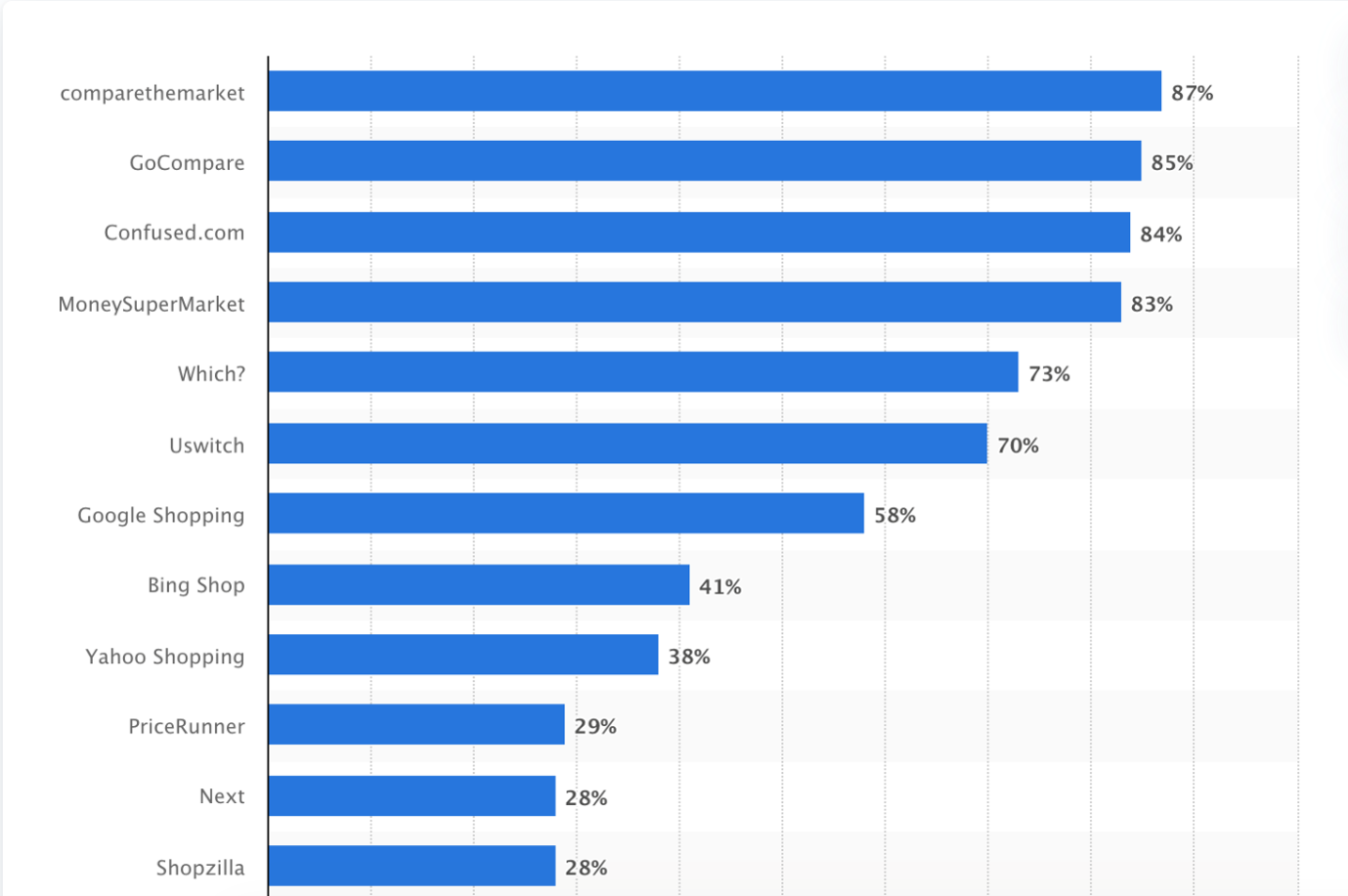
For a challenger, this chart illustrates the challenge in a nutshell. You can build an excellent comparison engine, offer competitive products and publish useful content, yet still be competing against companies whose names are already embedded in the consumer’s mental shortlist.
Why Pricing Comparison SEO Is A Difficult Race
Search competition is particularly unforgiving because the established platforms have accumulated advantages over many years. They have enormous content footprints covering everything from “how much is car insurance?” to highly transactional searches such as “compare car insurance”. Thousands of pages, substantial backlink profiles, established domains, strong internal linking structures and years of behavioural signals.
And they also have something that is difficult to replicate through SEO alone: brand search.

A consumer who searches directly for a comparison brand does not need to be won over by a generic result on page one. They already know where they want to go. Paid search can reinforce that familiarity, while television, radio, social media, sponsorships and memorable creative keep the brand visible outside the search results.
This is why trying to compete by simply publishing more articles can become an expensive exercise in producing content that nobody needs. The question is not, How many pages can we create? But: Which consumer questions are not being answered well, and where can our brand become genuinely useful?
From Search Visibility To Search Intent
A successful comparison platform needs to cover the consumer journey rather than one narrow point within it. At the early stage, someone might be asking, “What type of home insurance do I need?” A little further along, the question becomes, “How much does home insurance cost?” Then the questions become increasingly sophisticated and specific, “What should I look for when comparing home insurance?” And finally, “Compare home insurance quotes.”
These are different searches from an SEO perspective, but they are also different psychological moments. The consumer is moving from education to research, evaluation and eventually conversion. A strong financial comparison content strategy reflects that progression.
This means combining consumer guides, product explainers, comparison pages, “best” and “compare” content, calculators, market research, seasonal content and conversion-focused landing pages, rather than building a blog that exists separately from the commercial website.
And always keep in mind where that piece of content will take the reader next. A guide about the cost of car insurance might lead into an insurance calculator, whereas a savings guide might link to relevant savings-account comparisons.
The objective is not to push every visitor into a quote form immediately. It is to build enough relevance and trust that the next step feels useful rather than forced.
SEO Foundations Still Matter
There is no secret technical shortcut that suddenly makes a challenger more authoritative than an established comparison platform. The fundamentals still matter, particularly when a website contains hundreds or thousands of product, provider and location pages.
For comparison sites, that means paying particular attention to:
- High-intent comparison pages built around genuine commercial searches rather than thin variations of the same page.
- Scalable landing-page architecture that allows new products, providers, regions and categories to be added without creating a technical mess.
- Topic clusters and topical authority, connecting commercial pages with genuinely useful supporting information.
- Long-tail and question-based searches, particularly where large competitors have concentrated on the obvious head terms.
- Internal linking, so authority and context flow naturally between guides, comparisons, tools and product pages.
- Original data and research, giving the site something worth citing rather than simply rewriting information already available elsewhere.
- Digital PR and link acquisition, particularly through research, commentary and proprietary insights that journalists and publishers can reference.
- Technical SEO and site performance, including crawlability, indexation, Core Web Vitals and mobile usability.
- Structured data, where appropriate, to help search engines understand the content and entities on the page.
- Content designed around genuine user intent, rather than pages created primarily to capture keywords.
That last point is becoming increasingly important. Search and answer engines have become better at understanding whether a page actually helps someone complete a task. A comparison website therefore has to be useful even before the customer is ready to convert.
Read more on What Is EEAT And How Do You Write Content For It?
GEO Changes The Comparison Game, Again
There is another layer now sitting on top of traditional SEO and that is generative search optimisation (GEO). Consumers increasingly use AI-powered search experiences to research financial products, ask questions, compare options and understand complicated topics. For comparison platforms, that creates both a threat and an opportunity.
Google launched its Search Generative AI performance reports on 3 June 2026, giving Search Console users dedicated visibility into performance from generative AI features including AI Overviews and AI Mode, as well as generative AI features in Discover. Google subsequently said the reports had been rolled out to all websites worldwide by 31 August 2026.
For a comparison site, GEO, or Generative Engine Optimisation, is not about inserting a few more keywords into an article and hoping ChatGPT notices. The opportunity is to become a source that AI search experiences can understand, evaluate and reference.
That requires authoritative information, clearly structured content, strong entities, original research, transparent methodologies and first-party data. It also means creating genuinely useful comparison information that answers the question behind the question.
Google itself says that people continue to click through when they want to explore a topic more deeply, with users increasingly seeking content such as in-depth reviews, original perspectives and first-hand information. So for comparison sites, an AI-generated answer may provide the shortlist, but the consumer can still need the underlying evidence before making a financial decision.
Read more on Are AI Summaries Killing Your SEO?
AI Should Not Become Your Content Factory
There is a temptation for comparison marketers to see AI primarily as a way to produce more pages, faster. However, this is not the most valuable way to use it. AI can be much more useful when treated as a competitive intelligence, personalisation and customer-experience tool. Let’s see how this works with an example. You can use AI to analyse search behaviour and customer intent, identify content gaps, detect emerging comparison demand and analyse competitor activity. The same technology can support recommendation engines, personalise customer journeys, automate internal data analysis and identify points where users abandon a comparison or quote journey.
Imagine discovering that thousands of visitors are reaching a comparison page on your site but leaving when asked to provide a particular piece of information. Likewise, if search data shows a sudden rise in queries around a new financial product, the opportunity may not simply be to write an article. It may be to create a new comparison category, calculator, explainer and supporting research around that demand.
AI becomes much more useful when it helps the business understand what consumers are trying to do, rather than simply helping writers produce another 1,500 words.
Social Is About Being Remembered
Let’s face it, financial comparison is not the most exciting category. Insurance policies, savings rates and utility tariffs do not exactly scream viral entertainment. Yet some of the biggest comparison brands have demonstrated that the sector can be made memorable through distinctive creatives and brand mascots.
Go.Compare is an obvious example. Its Gio Compario character and opera-singing advertising have given the brand an unusually distinctive identity. More recently, the company has evolved the role of Gio while retaining the character as a distinctive brand asset. Research-led work on the campaign reported a 19% increase in share of search and a 17% increase in brand consideration.

Google’s own case study on Go.Compare describes how the brand used its distinctive character while evolving the creative direction, with modelling used to assess the impact of YouTube, TV and other media.
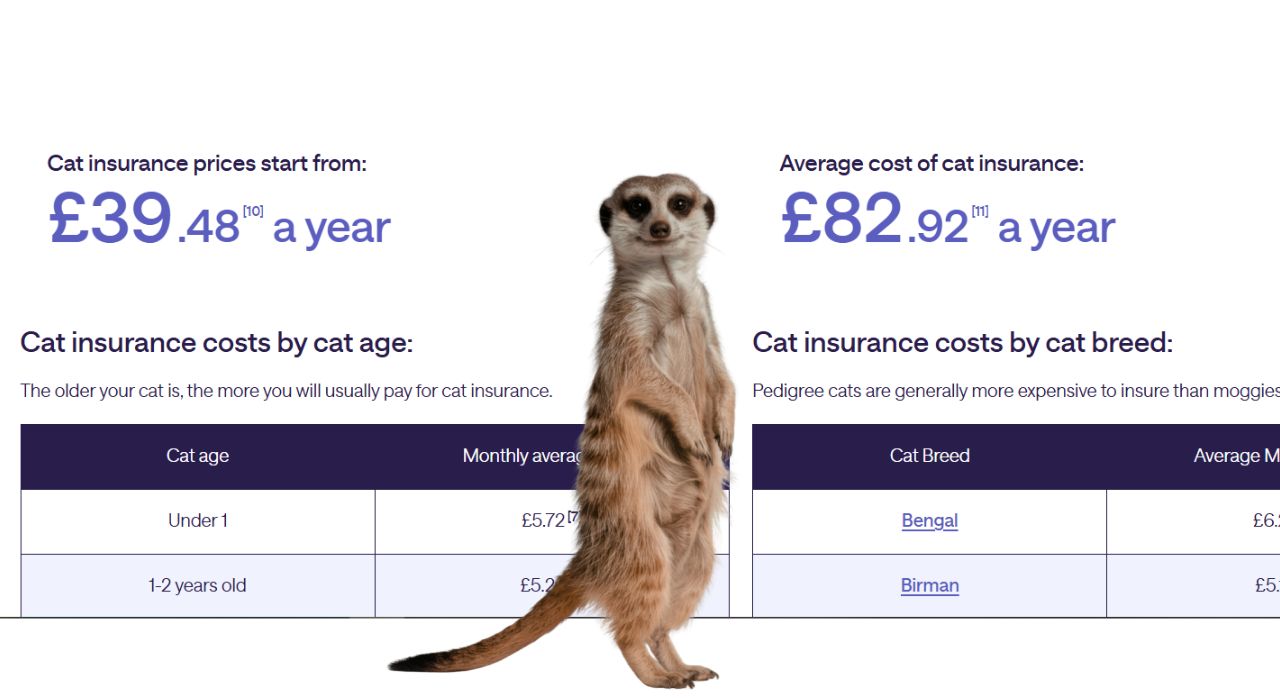
Compare the Market has taken a similarly long-term approach with its meerkat characters. Its 2026 “Me Time” campaign continues a relationship with the characters that has lasted more than 15 years, showing how a recurring creative asset can evolve rather than being replaced every time the marketing team changes direction.

MoneySuperMarket has also historically demonstrated how a comparison brand can create social and cultural conversation around a campaign rather than simply advertising a price. The famous “Epic Strut” campaign generated user remakes, social discussion and substantial earned media alongside the paid campaign.

The lesson for a challenger is not to copy a meerkat, an opera singer or a celebrity. It is to develop something recognisable enough to belong to the brand. Social media should give people a reason to remember the comparison site between transactions. Humour, expert commentary, consumer stories, useful financial tips, reactive content and recurring creative formats can all contribute to that memory structure.
Content Is Where Comparison Sites Create Differentiation
This is arguably the biggest opportunity for newer financial comparison platforms. An established competitor may have enormous domain authority, but that does not automatically mean it owns every useful conversation around a financial product. A comparison brand can build authority by becoming a financial information destination, not simply a place people visit when they are ready to compare prices. This can include consumer guides explaining unfamiliar products, market reports tracking price and rate movements, original research into consumer behaviour, savings data, seasonal financial content and expert commentary on market developments.
It can also include interactive tools and calculators that solve a real problem. A mortgage calculator, insurance excess calculator, savings calculator or cost comparison tool can be far more valuable than another generic article because it gives consumers something they can actually use. It can also create natural reasons for other websites to link to the brand.
There is a particularly interesting opportunity around “best” and “compare” searches. Consumers want these answers, but financial comparison requires more care than simply declaring one product the winner. A credible platform should explain its methodology, eligibility criteria, coverage, commercial relationships and the factors consumers should consider. The added benefit is that it creates a richer form of comparison content and it is relevant beyond mainstream insurance.
There are comparison and review sites covering forex brokers, banks, savings products, investment platforms, cards and other financial services. In forex, for example, traders routinely research brokers through comparison sites and independent review platforms before opening an account. Contentworks recently explored the commercial and reputational issues surrounding paid forex reviews, including the importance of understanding how rankings and review sites operate. Should Your Forex Broker Pay for Reviews?
For these forex and CFD focused sites, expertise can become the differentiator. A comparison site that explains spreads, regulation, withdrawal processes, account types, product limitations and trading platforms clearly is doing something considerably more useful than simply presenting a list of providers.
Trust Is Not A Compliance Footnote
Financial comparison has an additional challenge that fashion and travel comparison sites do not always face. The consumer is making decisions about money and falls into the YMYL category. That means trust cannot sit at the bottom of the website in a small “About our methodology” link. It needs to be visible throughout the customer journey.
The FCA has previously highlighted concerns around price comparison websites, including the risk that consumers focus too heavily on headline price or brand and overlook important features such as cover and exclusions. Its review emphasised the importance of helping consumers make an informed and balanced decision. The principle is highly relevant to comparison marketing.
Consumers should be able to understand how comparisons are produced, which providers are included, what criteria are being used, how rankings are determined and where commercial relationships exist. If a site receives commission from providers, that relationship should not be hidden behind vague language. If some providers are excluded, you need to explain why. Or, if you highlight a product because it meets particular criteria, tell the user what those criteria are.
Where Contentworks Fits
At Contentworks, we work exclusively with financial brands, so we understand why comparison marketing is different from selling trainers, holidays or consumer electronics. Financial content needs to balance acquisition with accuracy, commercial objectives with consumer usefulness, and creativity with regulatory considerations. It also needs to work across search, AI search, social, PR and the website rather than living in separate marketing silos.
Our team of experts can deliver complex financial content, large content programmes, SEO and GEO strategy, research-led projects or whitepapers, digital PR, social media content and financial brand positioning. We often support internal marketing teams with additional strategic and production capacity for bulky, technical or time-consuming content.
Book a Zoom with the Contentworks team to discuss your comparison marketing strategy.