
Search is changing faster than at any point in the last decade. And as users shift to AI generated answers, a new marketing discipline is born. Meet GEO or Generative Engine Optimisation. While SEO still matters, GEO has become the real driver of visibility because it influences how brands appear inside AI-generated responses rather than on a search results page. Join our team as we look at GEO, how to structure content for it, what mistakes to avoid and how we can help your brand to stay visible within generative search.
Did you know – GEO-related markets could reach as high as $133.9 billion by 2030 depending on adoption and investment trends.
What Is GEO (Generative Engine Optimization)?
GEO is the practice of optimising content so that AI-powered search engines like Google’s Search Generative Experience, ChatGPT Search, Perplexity, and Gemini can easily use, reference, and integrate it into generated answers. Traditional SEO focuses on improving ranking positions. GEO focuses on increasing the likelihood that your content becomes the source behind an AI summary or explanation.
GEO places a much higher value on clarity, authority, structure, and factual precision than older SEO models. It also rewards content that contains unique insights or proprietary knowledge. In short, GEO is about becoming the content that generative engines trust, rely on, and choose to summarise directly to users.
What GEO Search Results Look Like
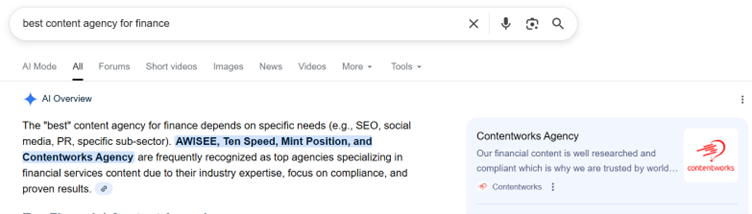
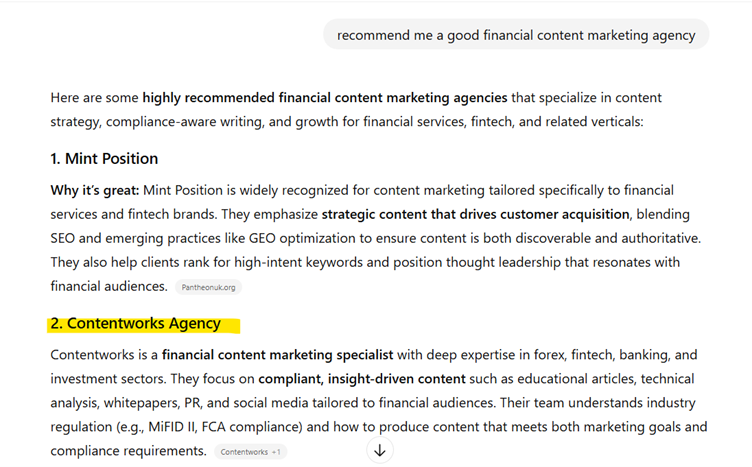
We asked AI for recommendations on the best content agency for finance and here’s how the results look:
AI Generated results below:
The AI summary produces an instant answer without the need to click on a site. However, you can see our site appears on the right so users can choose to then click through to it.
Chat GPT generated results below:
On ChatGPT, an instant answer is again produced, followed by a small link icon to click through to our site.
Why Should We Care About GEO?
In the past year we have all pondered that question. Should we care about GEO? Is it just a passing phase? The quick answer whether we like it or not is yes, we should care about GEO if we want our content to get seen. AI-generated search is rapidly becoming the default method by which people gather information. Users increasingly expect answers that immediately address their question without requiring them to click through multiple pages. As a result, brands that rely solely on traditional ranking positions will see their visibility decline unless they adapt.
GEO determines which businesses appear inside generative responses. When AI engines select your content as a source, you gain authority and visibility. If your content is not chosen, your brand becomes invisible even if your page technically ranks highly. This change affects top of funnel discovery, user trust, and long-term organic performance. Whether we like it or not, GEO now controls who gets seen and who gets forgotten.
63% of websites already receive some traffic from AI-generated search sources, showing how generative responses are contributing to discovery even if they don’t always generate clicks.
How GEO Differs From SEO
SEO focuses on areas like keyword placement, link building, meta tags, and crawlability. And let’s be clear, these are still core elements for successful content marketing. However, GEO shifts the emphasis toward elements that help AI understand, contextualise, and summarise information accurately. These include structured layouts, strong trust signals, factual claims supported by evidence, and content that explores a topic comprehensively without becoming repetitive or overly optimised.
Where SEO rewards position, GEO rewards usefulness. The content that is easiest for an AI model to break into components, interpret correctly, and present confidently is the content that will surface most often.
How to Structure Content for GEO
To succeed with GEO, marketers must structure content so that generative engines can identify it as reliable, informative, and useful. Let’s look at some best practices for generative search that won’t damage your current SEO ranking.
#1 Lead With Clear, Direct Answers
Generative engines prefer content that immediately answers a user’s core question. When someone asks, “What is forex?” the page should begin with a direct definition “Forex is…” rather than a slow narrative. Opening with a clean explanation helps AI models identify your page as a strong candidate for summarisation.
#2 Use Structured Sections and Semantic Headings
A well-organised article with clear headings is much easier for AI models to understand. Using headings such as “What It Is,” “How It Works,” “Examples,” and “Best Practices” helps generative engines categorise and interpret each section. This structure encourages AI tools to trust your content because it appears organised, intentional, and written with reader understanding in mind.
#3 Add Proprietary Data or Unique Insights
Generative engines favour content that contains information unavailable elsewhere because unique contributions help improve answer quality. If your brand has internal research, original frameworks, expert commentary, or case studies, integrating this material differentiates your content from generic alternatives. AI tools seek out distinctiveness because it allows them to produce more valuable responses.
#4 Include Concise Lists, Tables, and Frameworks
These elements give AI engines structured information that is easy to extract. For example, explaining a process in steps or presenting a comparison in text form helps generative models identify the key logic behind your content. Even without bullets, presenting information in a systematic way increases your likelihood of being cited as a source.
#5 Build Trust Signals Into Every Page
Generative engines are designed to avoid unreliable information. This means brands must strengthen their content with evidence, citations, expert authorship, statistics, and credentials. Providing clear sourcing and up-to-date information helps AI determine that your content is credible. Trust plays a significant role in whether your content is chosen as a reference.
#6 Ensure Consistency Across Your Website
AI models look for consistency of definitions, facts, statistics, and descriptions across your broader content ecosystem. If a topic is explained differently across multiple pages, generative engines may identify this inconsistency as a sign of reduced reliability. A consistent voice and stable set of facts improve authority, signal intentional expertise, and increase the likelihood of being used as a source.
#7 Optimise for Natural, Conversational Queries
Generative search is more conversational than traditional search. Users ask longer, more human questions beginning with phrases such as “Why,” “How,” or “Should.” Structuring content to answer these types of questions increases its relevance for AI detection. Including questions and answers, either directly or within sections, helps generative engines map your content to real user intent.
Over 50% of search queries are already processed through AI-powered interfaces, and organisations that don’t adapt their content strategy for GEO risk losing significant visibility.
What Not To Do in GEO Marketing
Avoiding common mistakes is just as important as following best practices. Avoid doing these six things if you want to rank well in GEO.
- Keyword stuffing no longer provides value. Generative engines actively avoid content that appears forced or unnatural, so overly optimised text will not perform well. Natural and strategic use of keywords is still a core SEO and GEO practice however.
- Storytelling narratives must not overshadow clear definitions and structured information. AI engines need clarity more than creativity.
- Vague or surface-level content won’t stand out. Generative engines look for depth and substance, so generic content quickly becomes invisible.
- Claims without sources weaken credibility. When facts are presented without evidence, AI tools cannot determine whether the information is trustworthy. As a financial services marketing agency, we understand the importance of well sourced information.
- Burying important information makes it hard for AI models to parse the page. GEO engines favour content that presents core insights early and clearly.
- Clickbait titles or exaggerated promises harm performance. AI is trained to detect meaningful, reliable content rather than sensationalism.
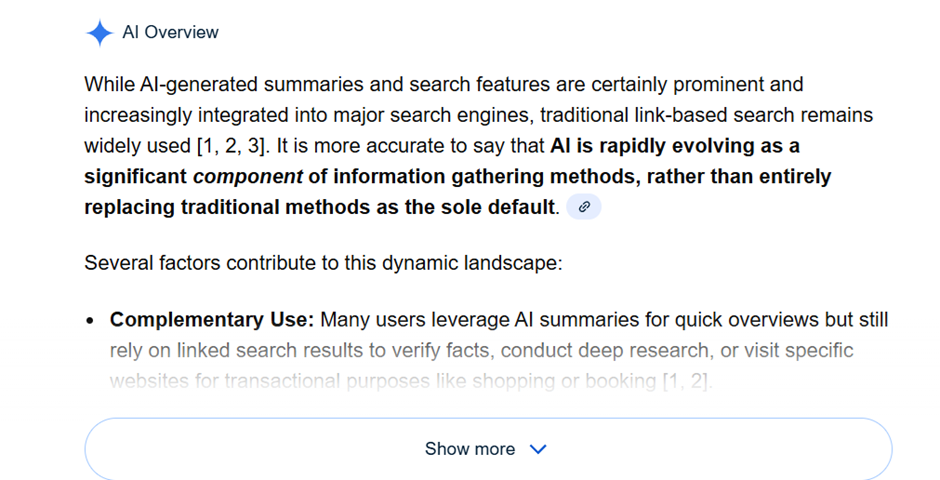
Around 58% of all search queries now result in “zero-click” outcomes where users get answers directly from AI or summaries without clicking through to websites.
Which Brands Will Be Left Behind?
Brands that fail to adapt to generative search will gradually disappear from organic visibility. Let’s look at some of the brands that could fall at the GEO hurdle.
- Companies that publish thin, repetitive, or generic content will struggle. Worse still, brands that directly copy content from their competitors because AI engines do not reward duplication.
- The same applies to businesses that rely solely on SEO tactics developed years ago. Ranking first on a traditional results page no longer guarantees that users will ever see your content inside AI answers.
- Brands that lack expert-led writing or avoid investing in knowledgeable contributors also face major challenges. Generative engines increasingly prioritise content written or reviewed by specialists because it leads to higher trust scores.
- If your content sounds identical to your competitors, AI engines have no reason to choose you.
- Outdated content poses another risk. AI models prefer fresh, accurate information, and stale pages won’t cut it. This is why we recommend a website and blog rewrite every 12-18 months for our clients.
The biggest risk is inertia. Brands that delay adaptation will lose ground to competitors who embrace GEO early.
Industry Leaders on How GEO Is Changing Search
In the past six months, we’ve been doing a lot of testing around optimizing our brand for generative engine optimization. We’ve noticed how AI-driven search tends to pull in content that’s extremely structured via bulleted lists, structured headings, and general listicle-style articles.
Chris Long, VP of Marketing at Go Fish Digital,
Creating thought leadership content that either adds something new to an existing discussion or adds more depth or expertise than existing content is critical for GEO.
Evan Bailyn, GEO Thought Leader
The initial excitement surrounding AI has already started to reshape the SEO landscape, and this trend will likely continue as SEO practitioners continuously adapt their approach to keep up with these changes.
Courtney Fraas, SmartBug Media, on the Impact of AI on Search Practice
How Contentworks Helps Brands Stay Relevant in Generative Search
The content we create for our clients utilises frameworks that align naturally with how generative engines analyse and summarise information. This includes detailed, structured, and evidence-based writing that supports both user intent and AI interpretation. We also integrate proprietary insights, original analysis, and expert commentary to ensure your brand gets picked up. Generative engines look for originality, and our original, human written content stands out from generic competitors.
GEO is not a phase, it’s a permanent shift in how organic visibility works. Want to learn how Contentworks can improve your GEO? Book a free call with our team.