
Fintech remains one of the fastest-growing sectors. In 2026, global fintech revenues are projected to exceed $300 billion, reflecting sustained double-digit annual growth. But rapid growth doesn’t necessarily make marketing easier. In fact, it often makes it more expensive and more competitive. Digital advertising budgets in fintech have increased by roughly 45% as companies vie for visibility and user attention. At the same time, customer acquisition costs in financial services are significantly higher than in other industries with modest conversion rates. But there are ways that fintechs can increase their acquisition, reduce their outgoings and manage solid retention rates. Let’s look at the biggest fintech marketing mistakes to avoid.
#1 Underestimating The Trust Deficit
Trust remains fintech’s biggest growth constraint. Only 56% of people worldwide trust financial services companies, making it one of the least trusted sectors. With the rise of online transactions, decentralised finance, and anonymous crypto wallets, consumers are more cautious than ever before. Meanwhile, 60% of consumers express concerns about data security, fraud protection, and privacy when using digital financial services. The takeaway is clear. In fintech, trust is not inherited. It must be earned through transparency, proof, compliance clarity, and consistent communication, especially for newer brands without established reputations.
#2 Letting Acquisition Costs Balloon Without Sustainable ROI
Customer acquisition cost in financial services is among the highest of any digital sector. Recent industry benchmarks indicate that fintech customer acquisition costs (CAC) for B2B/SMB services range from $500 to over $1,500 per funded customer, with enterprise-focused fintechs experiencing costs as high as $14,772 depending on product and region.
At the same time, analysis from BCG and McKinsey has found that many venture-backed fintechs have historically spent close to or above 100% of customer lifetime value on acquisition during aggressive growth phases. With digital ad costs rising year over year on platforms like Google and Meta, the margin for inefficiency is shrinking. The insight is simple. Growth that does not translate into profitable lifetime value is not scale, it is burn. We see this fintech marketing mistake time and time again with fintech startups. Especially those that have raised early stage funding and are quick to blow it without a strategy.
#3 Failing At Retention Because Of Poor Onboarding
Acquisition means little without activation and retention. The average 30 day retention for finance apps often sits between 10% and 20%, meaning the majority of users churn within the first month. Multiple UX studies across financial apps indicate onboarding drop off rates of 60% or higher when KYC processes are slow or confusing. Given high CAC, this leakage is costly. The takeaway is that first deposit, KYC completion, and early engagement events matter more than raw sign ups. Optimising onboarding can have a greater impact on revenue than increasing top of funnel spend. From a fintech marketing perspective, it’s all about comprehensive education and top tier support. Your fintech education centre should answer every possible onboarding question and support customers in their signup journey.
#4 Prioritising Features Over Outcomes In Messaging
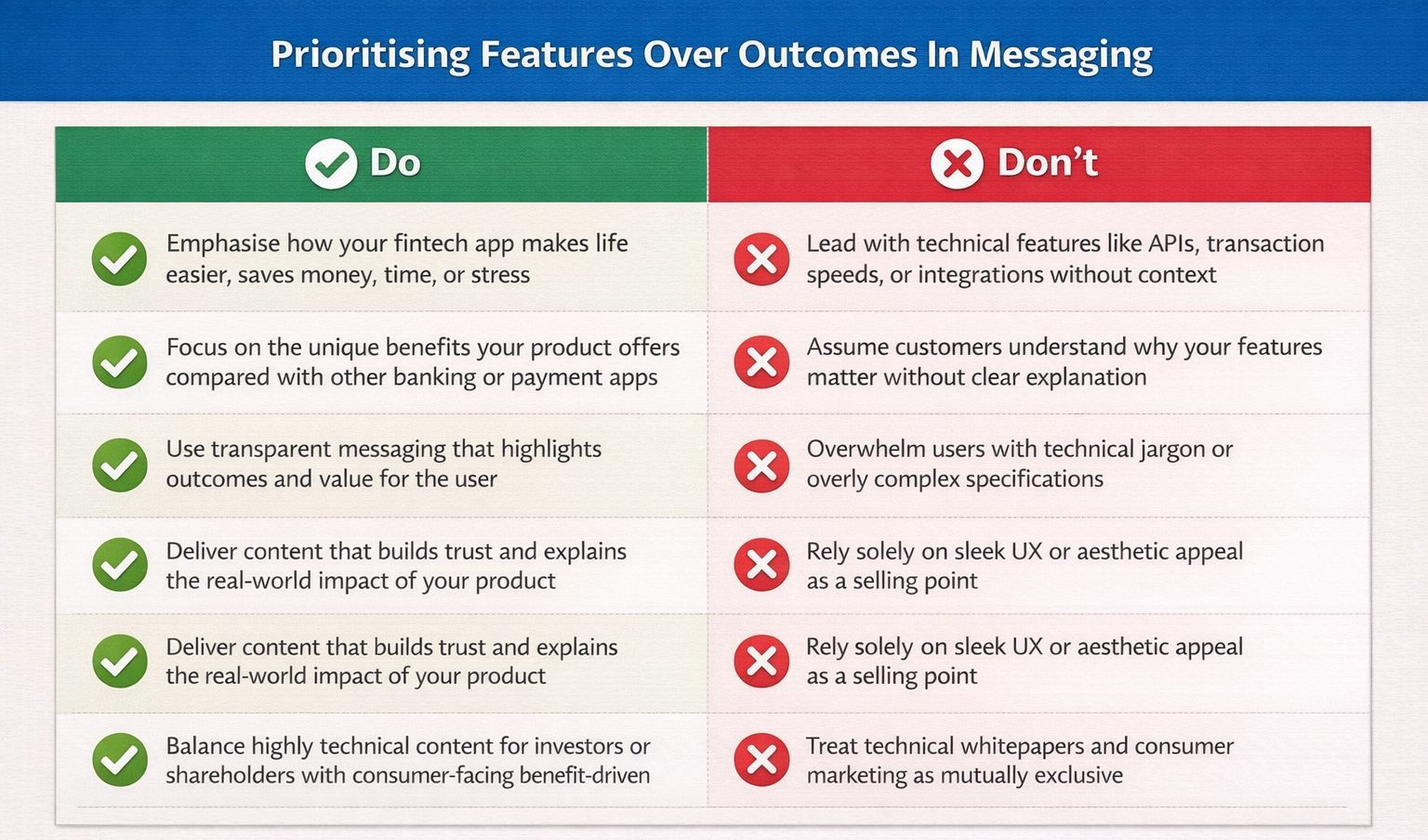
Many fintechs lead with product features such as APIs, transaction speeds, or integrations. But here’s a marketing truth. Most customers don’t care. They want to know how your app will benefit them. How it will save them money, time or stress. What features it has that their other banking or payment apps don’t have. The problem is, many fintech founders don’t know. Or they get so caught up in the technical details they miss the obvious. Research shows that customers respond more strongly to clear value, outcomes, and transparency than technical specifications. In negative financial services reviews, sentiment frequently centers on hidden fees, unclear terms, or unmet expectations rather than tech features. We deliver highly technical whitepapers that win fintech investment and shareholder buy-in. Whilst also delivering meaningful benefit driven content for consumers. These two fintech marketing elements can happily coexist together.
#5 Ignoring Personalisation And Data Driven Targeting
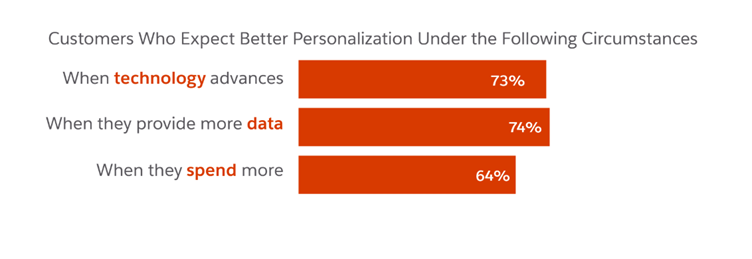
Personalisation is no longer optional. Salesforce research shows that 73% of consumers expect companies to understand their unique needs, and 76% become frustrated when that expectation is not met. 69% of consumers read online reviews before engaging with a financial brand, highlighting how relevance and social proof directly influence decision-making. Fintech firms that implement segmentation, behavioural triggers, and lifecycle-based messaging consistently outperform those relying on broad, one-size-fits-all campaigns.
In fintech specifically, where trust, risk perception, and financial sensitivity are high, personalisation is not just a conversion tactic. It is a credibility signal. The brands that win are those that use data intelligently to deliver the right message at the right stage of the customer journey, reducing friction, strengthening trust, and compounding lifetime value rather than simply driving clicks.
#6 Chasing Channel Hype Instead Of Strategy
Here’s a common fintech mistake we hear frequently. “We want to have influencers on TikTok/IG!” One of the most damaging mistakes in fintech marketing is chasing trends like influencer campaigns on TikTok or Instagram without first building a strong strategic foundation. While influencer marketing can drive visibility, finance is a high-trust, high-risk category where credibility matters more than reach. Promoting complex financial products using celebs or influencers can dilute brand authority, oversimplify regulated messaging, and attract low-intent audiences who are unlikely to convert or retain. Engaging influencers without a clear strategy and core content marketing in place is a huge money drain. Additionally, influencer marketing requires expert oversight to read beyond vanity metrics and analyse the real ROI.
#7 Thinking Fintech Content Marketing Is Just For Launch
Fintech content marketing cannot be treated as a one-time launch tactic. It must be a sustained strategy to remain discoverable in 2026. Google’s algorithms now consider content freshness a meaningful ranking signal. About 6% of current ranking factors weigh freshness and update frequency, and pages updated at least once per year can rise an average of 4.6 positions in search results compared with pages that remain unchanged. Regularly publishing new SEO/GEO optimised content, ideally weekly, signals relevance to both Google and users and keeps your brand visible for a wider range of discovery queries. This publishing rhythm also helps capture long-tail keywords and evolving search intent, which static content cannot achieve on its own.
To be organically ranked as best fintech marketing agency our team prioritises helpful customer content and regularly updated education.
Adding new articles is only part of the strategy. Older content needs systematic renewal, especially in fast-moving sectors where regulations, product features, and market conditions change frequently. Research shows that updating existing content every three to six months while also adding weekly or daily updates for breaking developments maintains relevance and prevents content decay, where rankings drop simply because information becomes outdated. Combining fresh content production with regular audits and updates improves SEO performance, builds user trust, and reinforces authority in the fintech sector over time.
Get Strategic About Your Fintech Marketing
At Contentworks Agency, fintech marketing is not a trend for us. It is a discipline we have refined over more than 10 years working exclusively within financial services, FX, and fintech. We understand the regulatory pressures, compliance nuances, acquisition economics, and trust barriers that define this sector because we operate in it every day. Our team has supported some of the industry’s largest fintech and trading brands through global launches, rebrands, market expansions, and reputation management strategies.
We work create fintech content marketing strategies designed to strengthen brand authority, accelerate discoverability and improve retention. In high-trust sectors, experience matters, and we bring a decade of proven sector expertise to every fintech. Book a free call with our team.